MLflow is an open-source MLOps platform for managing machine-learning experimentation, reproducibility, deployment, and model registration. It preserves training metadata and artifacts so teams can compare experiments, reproduce models, and troubleshoot performance degradation. section 8.0 section 8.4.2
Organize the platform around four components:
- MLflow Tracking records and queries run metadata such as parameters, metrics, and tags. section 8.4.2
- MLflow Projects packages code for reusable and reproducible execution. section 8.4.2
- MLflow Models packages models for use with different serving tools. section 8.4.2
- MLflow Model Registry manages lineage, versions, annotations, and production promotion through a user interface. section 8.4.2
A common deployment uses a remote tracking server with proxied artifact storage. Pipeline steps send metadata and artifacts through the MLflow client; the server stores metadata in SQL and artifacts such as models, images, and documents in object storage. Proxying avoids giving users direct credentials to the remote store. section 8.4.2
Track a training run
Set the remote tracking URI, select an experiment, start a run, and log parameters, metrics, and files. The client API can also retrieve run metadata, experiments, and model versions through MlflowClient.
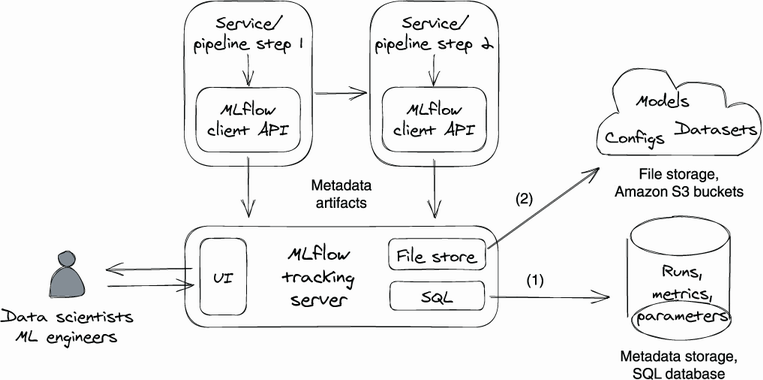
Use the architecture diagram to trace metadata ingestion and artifact access through the tracking server. section 8.4.2


