Mode seeking concentrates probability on one or a few high-probability modes instead of covering every mode of a target distribution. Reverse KL encourages this behavior because it evaluates regions sampled from the model itself. section 15.2.2
Reverse-KL mode seeking has two operational pressures:
- It can ignore target regions where the model assigns almost no probability, even when the target has substantial mass there. section 15.2.2
- It penalizes probability placed outside the target and concentrates on a high-probability or high-reward region. section 15.2.2
- In multimodal policies, this concentration can preserve an old mode while shifting a sampled new mode toward the target. section 15.2.2
Old and new policy modes
Suppose a policy contains an old mode representing prior knowledge and a new mode for a target task. Forward-KL SFT stretches the policy across both modes and can pull mass away from the old one. Reverse-KL RL can move the new mode toward the target without disturbing the old mode. section 15.2.2
Figure 15.1 Forgetting dynamics for forward KL (SFT) versus reverse KL (RL). The “old” mode represents prior knowledge, and the “new” mode represents the target task. Forward KL stretches the policy to cover the target and pulls mass away from the old mode (top right), whereas reverse KL shifts the new mode toward the target without disturbing the old mode (bottom right). From Chen et al. (2025), with permission of the author.
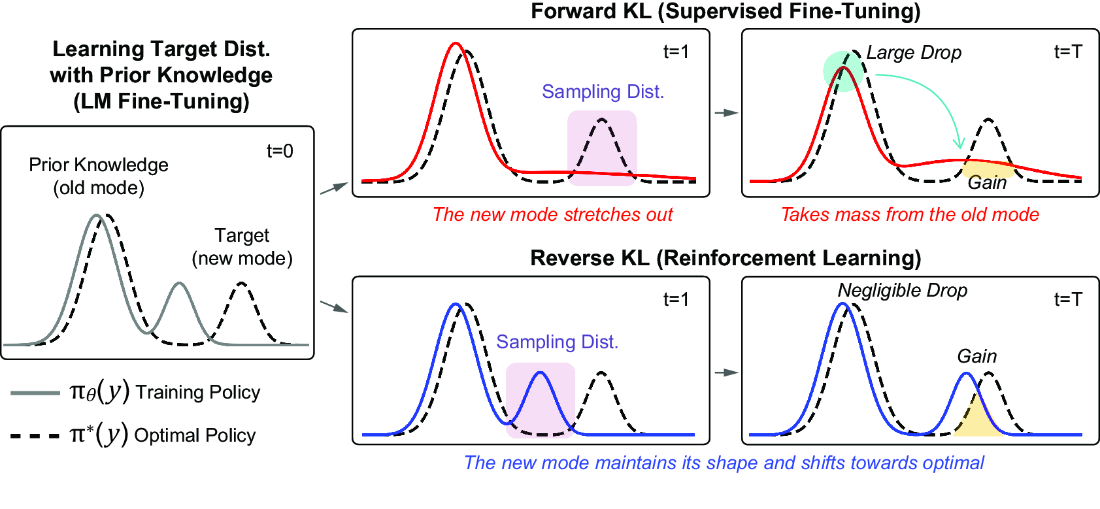
Compare the visualized forgetting dynamics of forward-KL SFT and reverse-KL RL across old and new modes. section 15.2.2
