Model-free optimization is a hyperparameter optimization approach that makes no assumptions about training code and ignores correlation between HPO trials. It treats each trial configuration independently, making grid search and random search its common methods. section 5.2.2
Use it to select hyperparameters for training code without modeling how one trial’s result predicts another’s. It fits the broader automatic HPO workflow, where compute and an algorithm search for hyperparameters that minimize a predefined loss on a dataset. section 5.2.2 section 5.5
The two common approaches differ in how they produce trial configurations:
- Grid search defines a limited value set for every hyperparameter, forms their Cartesian product, and evaluates trials using those grid values. section 5.2.2
- Random search samples configurations randomly from the specified hyperparameter space until its search budget is exhausted. section 5.2.2
- Grid search grows exponentially as more hyperparameters or larger spaces are added, and can spend substantial compute on nonoptimal regions because every candidate set is treated equally. section 5.2.2
Learning rate and batch-size search
A grid search can combine learning-rate values {0.1, 0.005, 0.001} with batch sizes {10, 40, 100}, producing trials such as (0.1, 10), (0.1, 40), and (0.1, 100). A random search instead samples from ranges such as learning rate [0.001, 0.1] and batch size [10, 100] until the budget ends. section 5.2.2
Figure 5.4 Comparison of grid search and random search for minimizing a function with one important and one unimportant parameter. (Source: Figure 1.1. of “Hyperparameter Optimization,” by Matthias Feurer and Frank Hutter, in AutoML: Methods, Systems, Challenges, eds. Frank Hutter, Lars Kotthoff, and Joaquin Vanschoren; Springer, 2019. www.automl.org/wp-content/uploads/2019/05/AutoML_Book_Chapter1.pdf)
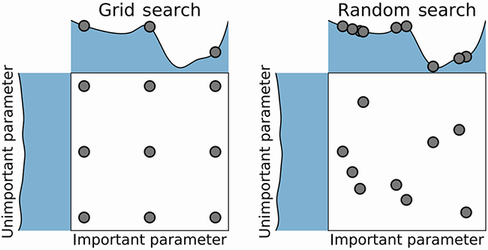
Compare how grid and random search cover a function with one important and one unimportant parameter. section 5.2.2
Model-free optimization is one of three broad HPO algorithm categories alongside Bayesian optimization and multifidelity optimization. No algorithm is universally best; choose according to the HPO task and its constraints. section 5.2.2 section 5.5
