A model partition is a subset of model parameters stored and updated by a particular parameter server. Partitioning lets distributed training handle models whose full parameter set cannot fit on one machine. section 1.3.2 section 3.2.2
A multi-server training workflow assigns responsibilities across workers and parameter servers:
- Workers consume separate dataset portions, calculate neural-network-layer results and gradients, and send updates to the relevant parameter server. section 3.2.2 section 7.3.2
- Parameter servers store and update designated model partitions, avoiding the need for one server to hold the complete model. section 1.3.2 section 3.2.2
- Asynchronous workers may use stale partitions, so systems continually push and pull parameter updates. section 3.2.2
- Balance worker and parameter-server counts carefully: simultaneous gradient traffic can cause blocking communication and create a bottleneck. section 7.3.2
Large-scale video classification
A model tagging unseen YouTube videos can distribute its parameters across multiple parameter servers. Workers process video-data subsets and update the partitions holding the model’s parameters, enabling training beyond a single machine’s capacity. section 3.2.2
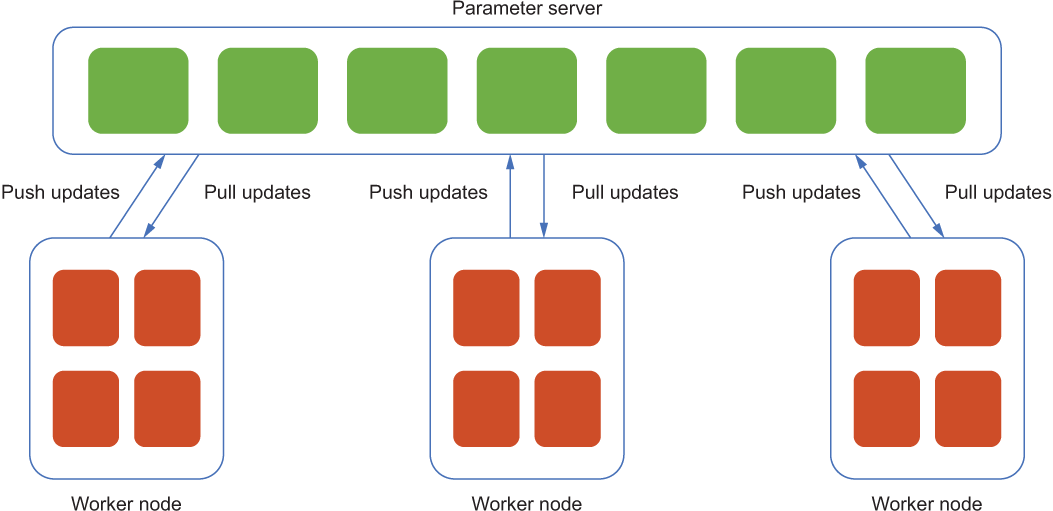
Use the architecture diagram to trace workers, multiple parameter servers, model partitions, and gradient updates. section 3.2.2
