A summarized model is a subset of a complete resource model. It retains the resource identifier and the main properties needed to represent a meaningful summary, commonly for search results and embedded resources. section 5.4.1 section 5.6
The Prefer header can request a summarized representation when creating or updating a resource with Prefer: model=summarized. This reduces returned data while preserving more context than an identifier-only response. section 13.5.2
Choose the model according to what consumers need:
- Use a summarized model for list results when identifiers and meaningful main properties let consumers work without reading every resource separately. section 5.4.1 section 9.5.2
- Embed a summarized related resource when consumers systematically need contextual details; use only an ID when the relationship is sufficient. section 8.7.3
- Prefer a complete response after creation or update when implementation-generated values matter; use model=summarized when consumers do not need the full resource. section 9.5.2 section 13.5.2
Requesting a summarized created resource
POST /account-applications with Prefer: model=summarized requests a 201 Created response containing the summarized account application model. Prefer: model=none omits the representation, while Prefer: model=minimal returns only its ID. section 13.5.2
Figure 5.16 Starting from the complete data model, we can design summarized (essential information), minimal (only the resource identifier property), and identifier (only the resource identifier value) models.
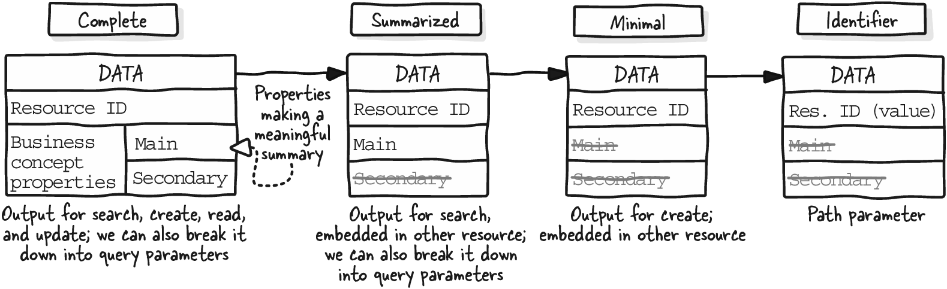
Trace how the complete model produces summarized, minimal, and identifier models. section 5.4.1
