A modern application delivers interactive, low-latency, connected, intelligent, context-aware, reliable, secure, and cross-device experiences. It improves through frequent updates and commonly runs as independently deployable services rather than a tightly coupled monolith. section 1.1
Its microservice structure supports practical operational and architectural goals:
- Evolve or replace constituent services independently. section 1.1
- Separate concerns and establish service contracts, making systems easier to inspect and repair. section 1.1
- Roll out changes incrementally, scale and reschedule services independently, and use distributed infrastructure efficiently. section 1.1
Modern applications may be built greenfield or refactored from brownfield systems. Their cloud native pattern fits distributed infrastructure and supports applications that are frequently updated, scalable, responsive, and reliable. section 1.1
Modernization paths
A modern app can be containerized, integrated with CI/CD, and run on Anthos before further microservice refactoring. Traditional Linux or Windows monoliths can be containerized with M4A, while workloads requiring legacy drivers or support can move to bare metal or Google Cloud VMware Engine for later refactoring. section 15.3.4
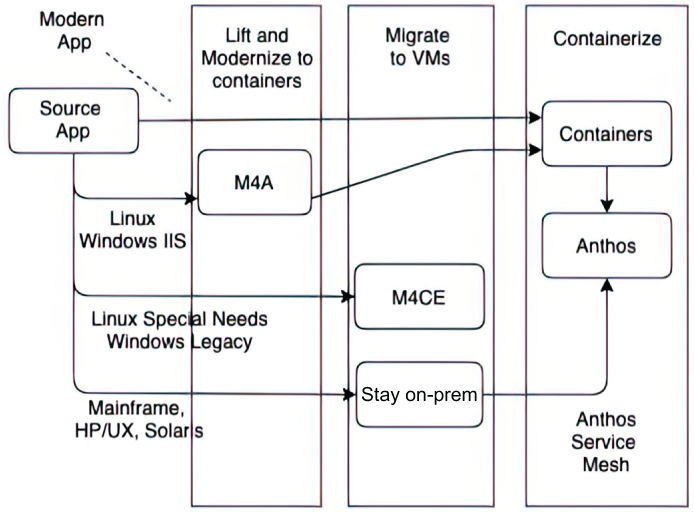
Use the modernization journey to compare containerization, Anthos deployment, direct VM migration, and later microservice refactoring. section 15.3.4

Use the Anthos component view to relate infrastructure management, application development, policy enforcement, and service observability across cloud and hybrid environments. section 6.0
