Modernization investment allocates resources to improve a particular architectural or business-domain area. Its value depends on choosing where modernization will produce meaningful business returns, rather than treating every subsystem as equally deserving of a rewrite. section 12.4 section 1.3
A sound investment balances return on investment, delivery delay, technical and organizational debt, and the urgency of business outcomes. Modernization works best as an evolutionary journey: discovery, architecture design, delivery, feedback, and learning continue in parallel rather than following a rigid sequence of phases. section 3.1.1 section 1.3
Use modernization investment to:
- Select an investment strategy for each subsystem instead of applying a uniform rewrite approach. section 12.4
- Sequence high-value opportunities while accounting for the cost of delaying other business outcomes. section 12.4 section 1.3
- Create space for teams to learn, adapt the roadmap, and respond to consequences discovered during delivery. section 1.3
When urgency overwhelms investment
A financially competitive organization demanded major product improvements within six months, but accumulated technology and organizational debt meant that a first line of modernized code took a year to reach production. Pressure encouraged blame, shortcuts, and new applications on old infrastructure. Earlier recognition of the required commitment could have supported a more gradual response. section 3.1.1
Figure 1.10 Identifying the optimal modernization return on investment per subdomain with the Modernization Strategy Selector
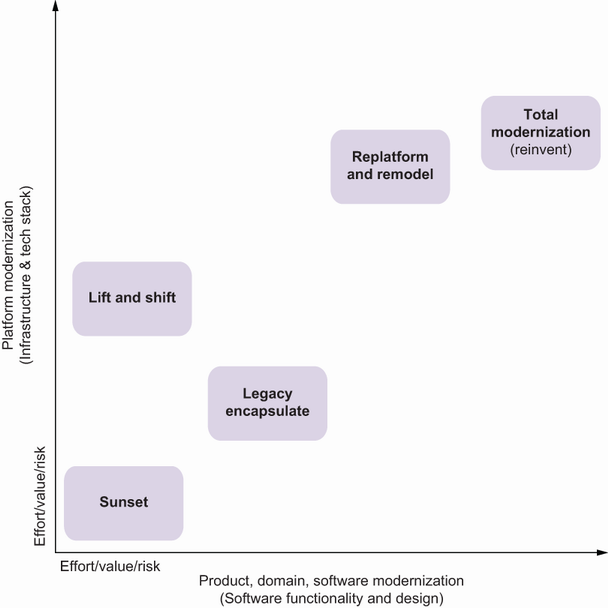
Use the Modernization Strategy Selector to compare the optimal return on investment for each subdomain and inform priority sequencing. section 1.3
