Modularity organizes software into smaller, self-contained units that perform particular tasks and can be developed, maintained, shared, and understood independently. In data science, it replaces a long notebook or Python script with an organized sequence of pipeline components. section 3.3
A modular machine learning workflow can separate responsibilities into files such as:
- 1 - process_data.py section 3.3.1
- 2 - feature_engineering.py section 3.3.1
- 3 - train_ml_model.py section 3.3.1
- 4 - generate_evaluation_metrics.py section 3.3.1
Separate functions and files improve readability and portability. A cleaning module can define functions for reading data, capping outliers, and coordinating those operations through a higher-level function. The guarded __main__ block allows other scripts to import these functions without executing the module's main code. section 3.3.1
Cleaning customer churn data
A script can define clean_data and import it elsewhere with `from code_modularization_example import clean_data`. The calling script reads the customer churn dataset and applies `customer_data = clean_data(customer_data)` without rerunning the module's complete execution workflow. section 3.3.1
Figure 3.1 This diagram demonstrates how we might organize a sequence of modular files, each performing a separate task as part of an overall goal - in this case, implementing a machine learning model.
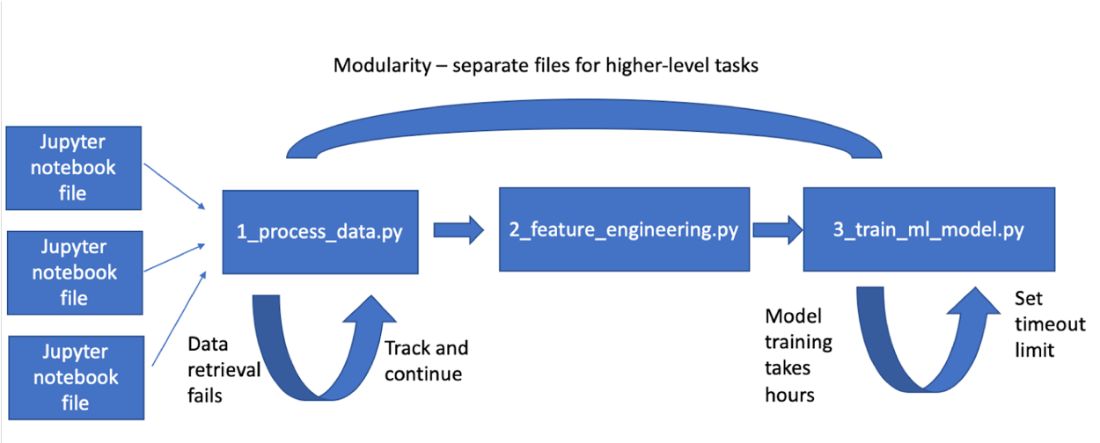
Use the workflow diagram to trace how separate files perform sequential tasks within an overall machine learning goal. section 3.3