A modulus is the number where arithmetic wraps around. Division by the modulus leaves a remainder, and numbers with the same remainder are equivalent in modular arithmetic. section 5.2.1
A clock that resets
With modulus 5, 7 divided by 5 leaves remainder 2, so 7 ≡ 2 (mod 5). The same rule maps 5 to 0, 6 to 1, and 9 to 4. section 5.2.1
Modular arithmetic supports several cryptographic operations:
- Modular multiplication reduces an ordinary product to its remainder; for example, 3 × 2 ≡ 1 (mod 5). section 5.2.1
- In a multiplicative group, modular inverses connect numbers whose product is equivalent to 1. section 5.2.1
- RSA raises a message to a public exponent modulo a public modulus; practical RSA uses N = p × q rather than a single prime. section 6.3.1
Figure 5.5 The group of integers modulo the prime number 5 can be pictured as a clock that resets to 0 after the number 4. Thus 5 is represented as 0, 6 as 1, 7 as 2, 8 as 3, 9 as 4, 10 as 0, and so on.
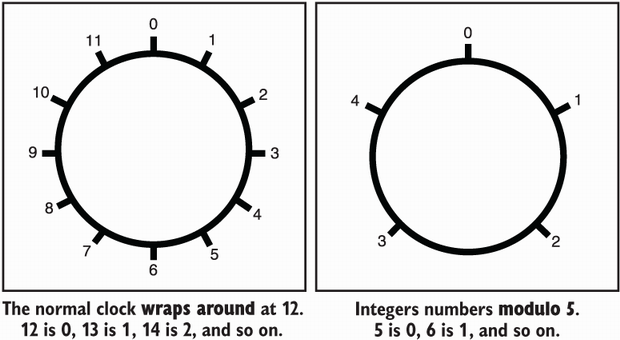
Use the clock diagram to see how integers modulo 5 cycle through 0, 1, 2, 3, and 4. section 5.2.1


