Moesif collects, analyzes, and reports API experience and usage data. For an API product team, its role is to turn developer activity into metrics that can guide improvements. Daily active users (DAU) are users who make a production API call; increasing DAU is the hypothesis for increasing monthly active users (MAU), not a guaranteed result. section 11.1.4
Moesif provides predefined API analytics reports and integrates with the Kong API gateway. As an agent-based monitoring tool, it requires a lightweight monitoring agent on the target system, unlike agentless tools that read data through network protocols or built-in agents. section 11.1.4 section 11.2.3
A practical measurement workflow starts with a specific developer-journey question:
- To track acquisition, send Moesif a user-action event when a developer signs up for a portal account and receives an API key. Save a time-series chart of daily sign-ups to share the trend. section 11.1.4
- To track use, define DAU around production API calls. Report criteria can select calls with an /api base path; a time-series chart then shows the resulting DAU trend. section 11.1.4
- To examine the journey after sign-up, use lookup and funnel reports for recently signed-up users, time-to-first-hello-world (TTFHW), first production calls, and conversion. section 11.1.4
Figure 11.7 The workflow file simulates user sign-ups to a developer portal and API calls to the gateway. It sends the associated user action events and API call events to Moesif.
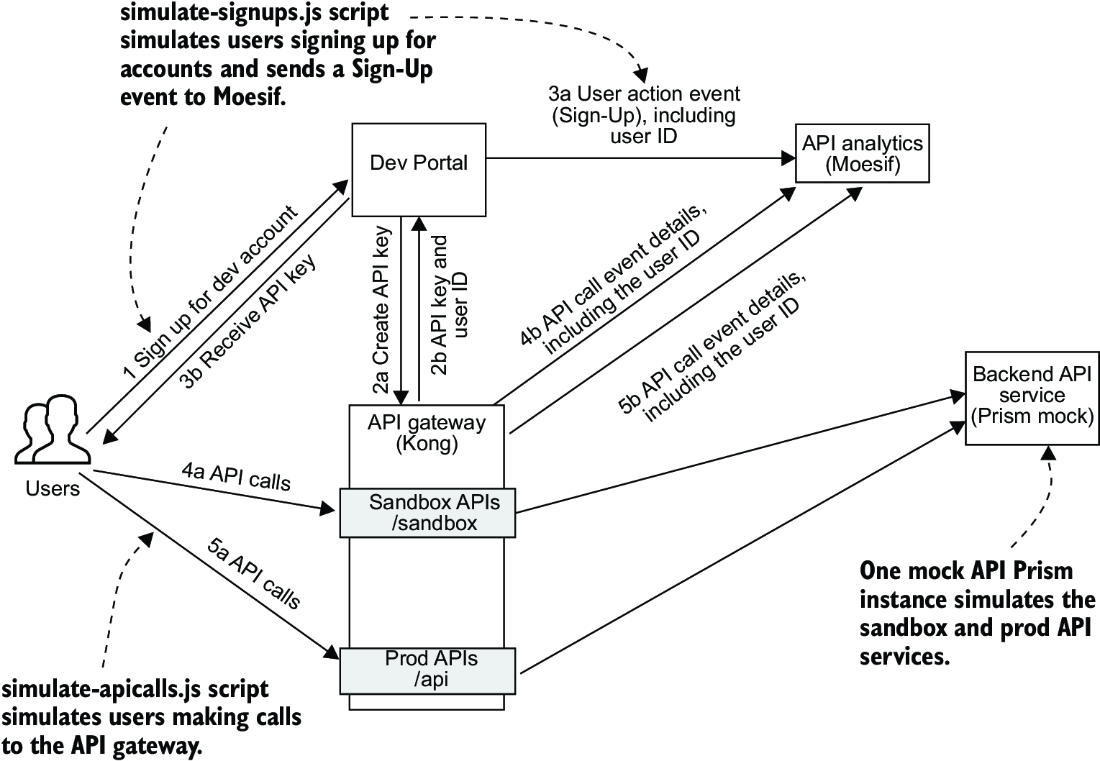
The workflow diagram connects simulated developer sign-ups and gateway API calls to the user-action and API-call events sent to Moesif. section 11.1.4
Reading a funnel result
In one example run, six users made API calls after signing up; their group's TTFHW was 6 minutes 19 seconds. Read that duration alongside the funnel's conversion result: the time describes users who reached the API-call step, not everyone who signed up. section 11.1.4
