A molecular conformation, or conformer, is one three-dimensional arrangement of a molecule’s atoms. A flexible molecule can adopt different conformations without changing which atoms are connected. For example, rotation around bonds can change the spacing between functional groups. section 5.3.3 section 7.3.2
Conformation matters in drug discovery because both a candidate molecule and its target can change shape. When they bind, both adjust toward an arrangement that lowers the system’s overall free energy. Docking searches for a low-energy arrangement of a compound in a target’s binding pocket, but this search can be computationally expensive. section 1.1.1 section 1.3.1
Proteins explore distributions of conformations rather than acting as rigid structures. Their many atoms and rotatable bonds make them harder to model than small molecules. RNA also changes shape: a binding pocket visible in one structure may not persist as the RNA flexes. section 9.1.1 section 6.0
Conformers in a prediction model
For CYP 3A4 inhibition, conformational sampling can generate a set of conformers for each molecule and calculate three-dimensional descriptors for each one. Multi-instance learning assigns a label to the molecule’s whole set, or bag. A bag-wrapper approach combines descriptors before prediction; an instance-wrapper approach predicts for each conformer and then combines the predictions. The idea is that some conformers may be more relevant to inhibition than others. section 5.3.3
Figure 5.11 Comparison of bag-wrapper and instance-wrapper variants of multiple-instance learning.
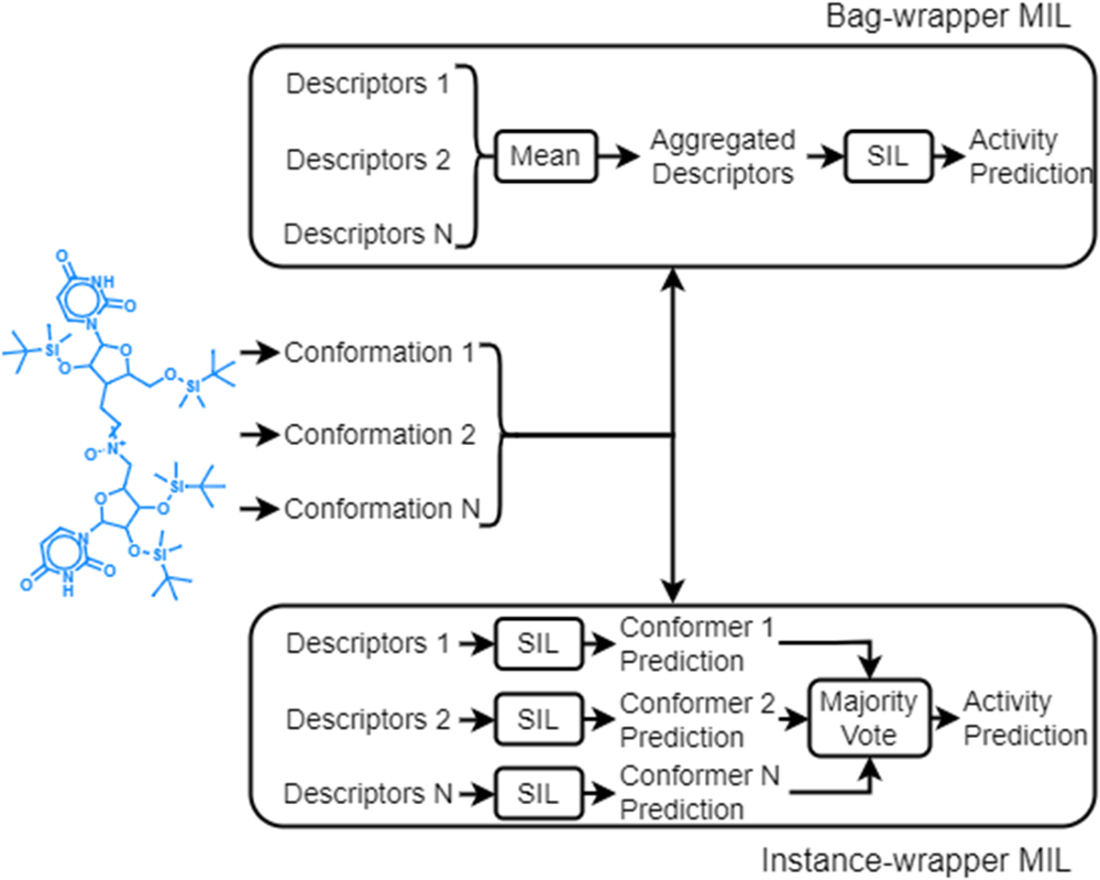
Compare where bag-wrapper and instance-wrapper methods combine information from conformers. section 5.3.3
Conformers also help identify a pharmacophore: a set of molecular features associated with activity. In ligand-based modeling, generate reasonable conformers, annotate their interaction features, and align conformers from different compounds to find common features. Validate the resulting features on an external test set; a flexible compound may adopt shapes where its functional groups are too poorly spaced to match. section 7.3.2
