Momentum improves stochastic gradient descent by combining the current gradient with previous parameter updates. The accumulated movement can increase convergence speed and help the optimization process pass through local minima. section 2.4.3
Momentum is useful because it:
- Uses a physics-inspired velocity analogy: past gradients influence the next parameter movement. section 2.4.3
- Updates parameters from both the current gradient and the previous velocity rather than the current gradient alone. section 2.4.3
- Addresses slow convergence and getting stuck at local minima, although low-dimensional intuitions may not fully represent neural-network training. section 2.4.3
Naive momentum update
A basic implementation stores the previous velocity, combines it with the current gradient, updates the parameter, and then saves the new velocity for the next step. section 2.4.3
Figure 2.19 A local minimum and a global minimum
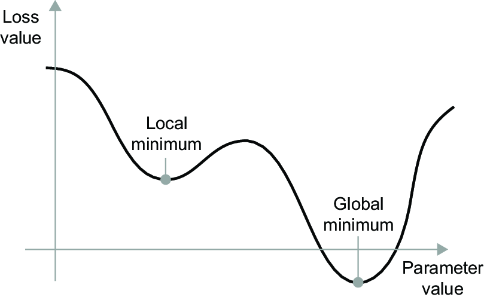
Compare a local minimum with a global minimum to see why ordinary gradient descent can stop prematurely and why momentum may continue moving. section 2.4.3





