A Monoid is a Haskell type class for values that can be combined associatively and that have an identity value. It extends Semigroup: `(<>)` combines two values, `mempty` leaves a value unchanged, and `mconcat` combines a list of values. section 7.3.1
Listing 7.9 Class signature for Monoid
class Semigroup a => Monoid a where
  mempty :: a  #1
  mappend :: a -> a -> a  #2
  mconcat :: [a] -> a  #3
  {-# MINIMAL mempty #-}
The class requires a Semigroup instance and supplies the neutral value; `mappend` is equivalent to `(<>)` by default, while `mconcat` combines a list. section 7.3.1
The required laws are `mempty <> a == a` and `a <> mempty == a`. Combination must also be associative, so parentheses can change without changing the result: `a <> (b <> c) == (a <> b) <> c`. The compiler does not verify these laws, and associativity does not mean that operand order may be swapped. section 7.3.1
Lists, strings, and numeric wrappers
Lists use `(++)` for `(<>)` and `[]` for `mempty`, so `[1,2,3] <> mempty <> [4,5,6]` produces `[1,2,3,4,5,6]`. Strings combine the same way. `Int` has no single canonical Monoid operation because both addition and multiplication are associative; `Sum` and `Product` select the intended operation. section 7.3.1
A custom data type can become a Monoid when it already has a meaningful associative append operation and a neutral empty value. For CSV data, `appendCsv` supplies `(<>)`, while a CSV with no header and no columns supplies `mempty`; this makes appending optional input a normal transformation step. section 7.3.1 section 8.4.1
Figure 7.1 Different scenarios when appending two tables of data
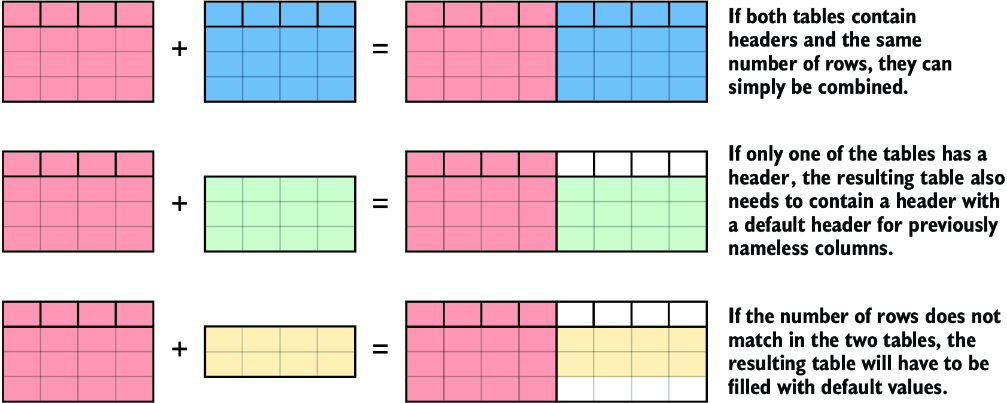
Appending CSV tables must account for headers, columns, and missing cells before it can serve as the associative combination operation. section 7.3.1


