A Morgan fingerprint is a circular molecular fingerprint that represents atom-centered neighborhoods within a chosen radius. It offers a practical molecular descriptor for screening, similarity searching, and machine-learning workflows. section 2.4.2 section 2.4.3
Generate the representation by:
- Starting from every atom and expanding radially through neighboring atoms up to the specified radius. section 2.4.2
- Hashing the resulting fragments into a fixed-length fingerprint, where binary bits record presence and count fingerprints record multiplicity. section 2.4.2
- Choosing parameters explicitly: radius 2 and 2048 bits provide a local, computationally inexpensive default, while larger radii capture broader structure. section 2.4.3
RDKit featurization
RDKit can create binary and count-based fingerprints with GetMorganGenerator(radius=2, fpSize=2048). Applying this function across a molecule column produces descriptors for a compound library. section 2.4.2 section 2.4.3
Drug-repurposing dataset
A COVID Moonshot workflow computed 2048-bit, radius-2 Morgan fingerprints for 2,062 synthesized compounds before dimensionality-reduction analysis; optional IC50 labels separated compounds below or above 5 μM. section 7.1
Figure 2.13 Circular fingerprints look for patterns extending radially from each start position, rather than patterns of linear structures. The example shows how the search is conducted for a radius of 2 at three different start points.
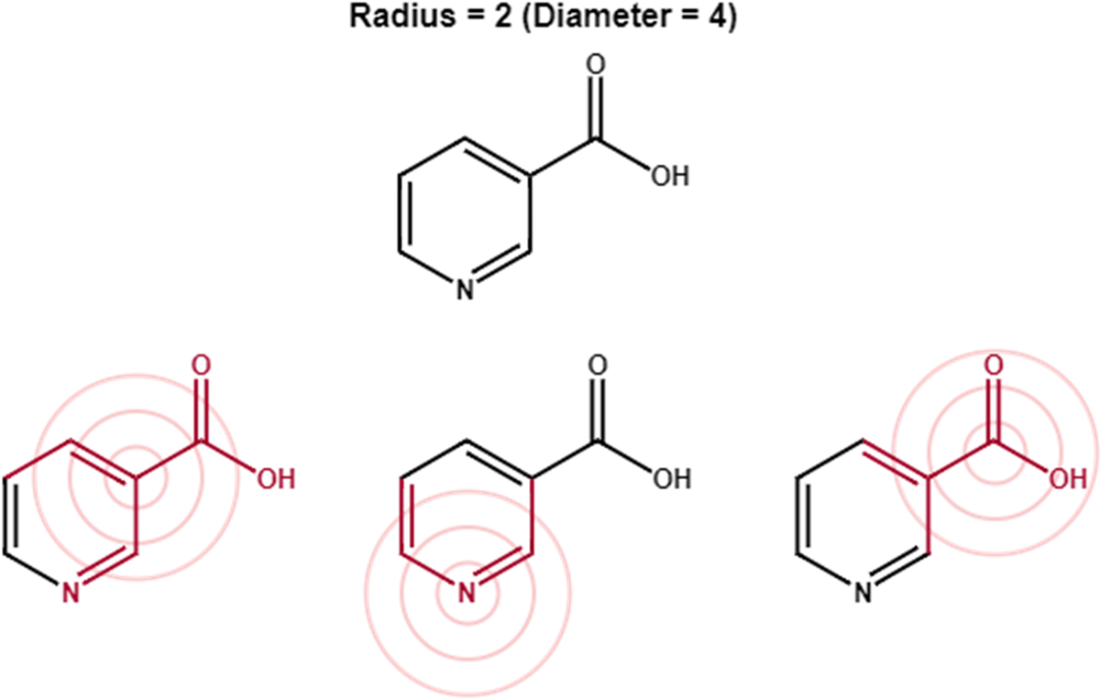
Use the radial-neighborhood figure to see how circular fingerprints inspect structures around multiple atom-centered start points. section 2.4.2
