Multi-area OSPF divides an autonomous system into smaller areas. Routers within an area share the same link-state database (LSDB), limiting database size, SPF calculation work, and the spread of network instability. section 18.1.2 section 18.5
Area 0 is the backbone. Every non-backbone area must connect to area 0, and inter-area traffic passes through it. An area border router (ABR) connects other areas to the backbone and maintains a separate LSDB for each connected area. section 18.1.2
Recognize the main OSPF router roles:
- Internal router: places all OSPF-enabled interfaces in one area. section 18.1.2
- Backbone router: has at least one interface in area 0. section 18.1.2
- ABR: connects one or more areas to area 0. section 18.1.2
- ASBR: connects the OSPF autonomous system to external networks. section 18.1.2
Figure 18.2 A multi-area OSPF network consisting of four areas. Area 0 is the backbone area to which other areas must connect. Areas 1, 2, and 3 are non-backbone areas, and traffic between them must pass through area 0.
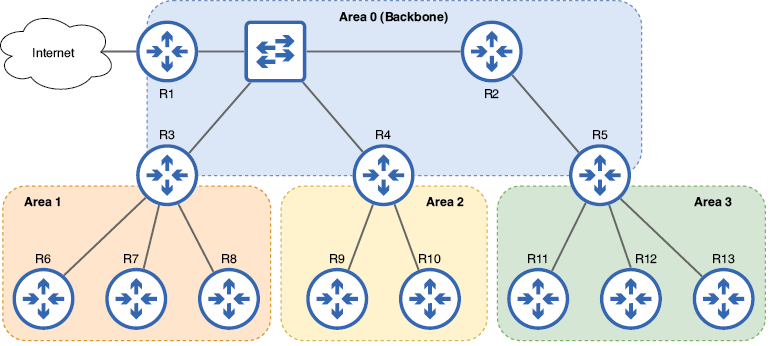
Use the four-area topology to visualize area 0, non-backbone areas, and the required path for inter-area traffic. section 18.1.2
