Multi-criteria decision making (MCDM) selects among models by combining results from tests that measure different, sometimes incomparable, aspects of performance. The aggregation method can change the selection, so its rationale should be explicit and documented. section 8.3.3 section 8.6
Use MCDM as an explicit selection artifact:
- List the tests that matter, including separate sets for hard-but-important cases and run-of-the-mill data. section 8.3.3
- Choose an aggregation method, such as weighted scores, rankings, or a Pareto front, based on the project’s decision needs. section 8.3.3 section 8.6
- Record the weights, trade-offs, assumptions, and unresolved judgment behind the final choice. section 8.3.3 section 8.6
Hard-but-important versus routine data
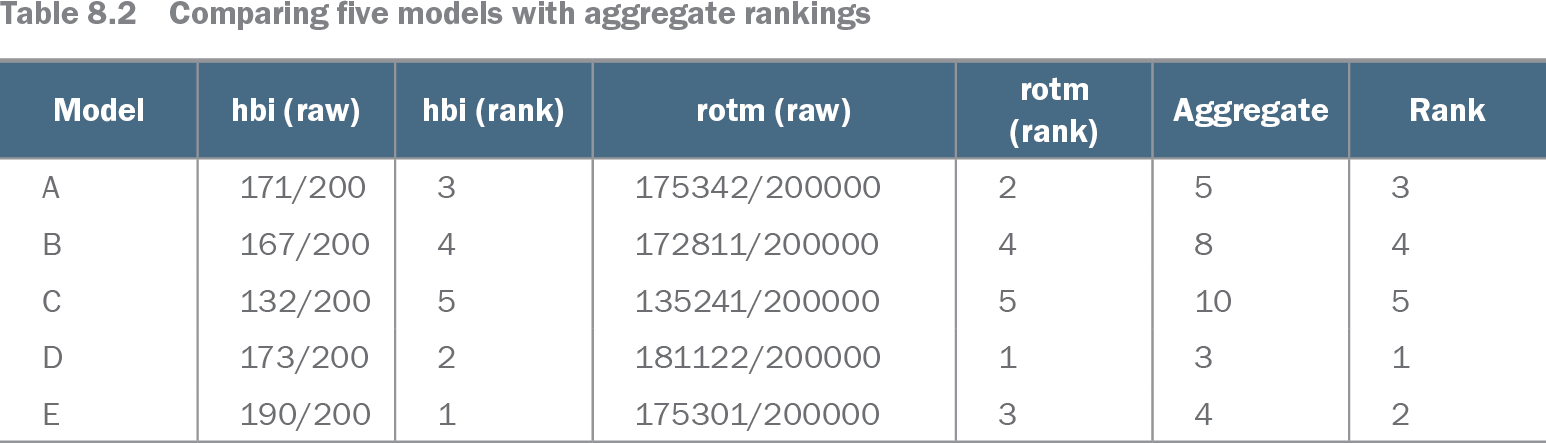
Suppose a test set contains 200 hard-but-important examples and 200,000 routine examples. A 50/50 aggregate can make each hard-but-important result worth 1,000 routine results, ensuring routine performance does not erase the targeted test’s purpose. The weighting remains a judgment: a small change in hard-case performance may outweigh a larger routine-data improvement. section 8.3.3
Table 8.2 Comparing five models with aggregate rankings (view table figure)
| Model |
hbi (raw) |
hbi (rank) |
rotm (raw) |
rotm (rank) |
Aggregate |
Rank |
|---|---|---|---|---|---|---|
| A |
171/200 |
3 |
175342/200000 |
2 |
5 |
3 |
| B |
167/200 |
4 |
172811/200000 |
4 |
8 |
4 |
| C |
132/200 |
5 |
135241/200000 |
5 |
10 |
5 |
| D |
173/200 |
2 |
181122/200000 |
1 |
3 |
1 |
| E |
190/200 |
1 |
175301/200000 |
3 |
4 |
2 |
Compare five models using raw test results, per-test ranks, aggregate rankings, and final selection order. section 8.3.3