When a shared cache is still a millisecond away, a server can keep a local copy close at hand. Multi-level caching puts a fast local cache (L1) in front of a shared distributed cache (L2)—like a sticky note on each desk and a whiteboard everyone can read. section 10.6
The speed comes with a coordination problem: when data changes, every server’s local copy must be refreshed or discarded. Otherwise, one page may show a new profile picture while another shows the old one. section 10.6
Local caching is most suitable when:
- The data is practically immutable, such as a list of US states, ZIP codes, or historical tax rates. section 10.6
- The extra speed is worth the risk and effort of keeping local copies consistent. section 10.6
Figure 10.8 Multi-Level Caching: The Local Cache (L1) is like a personal sticky note for blistering speed, while the Distributed Cache (L2) is a shared whiteboard for the entire system.
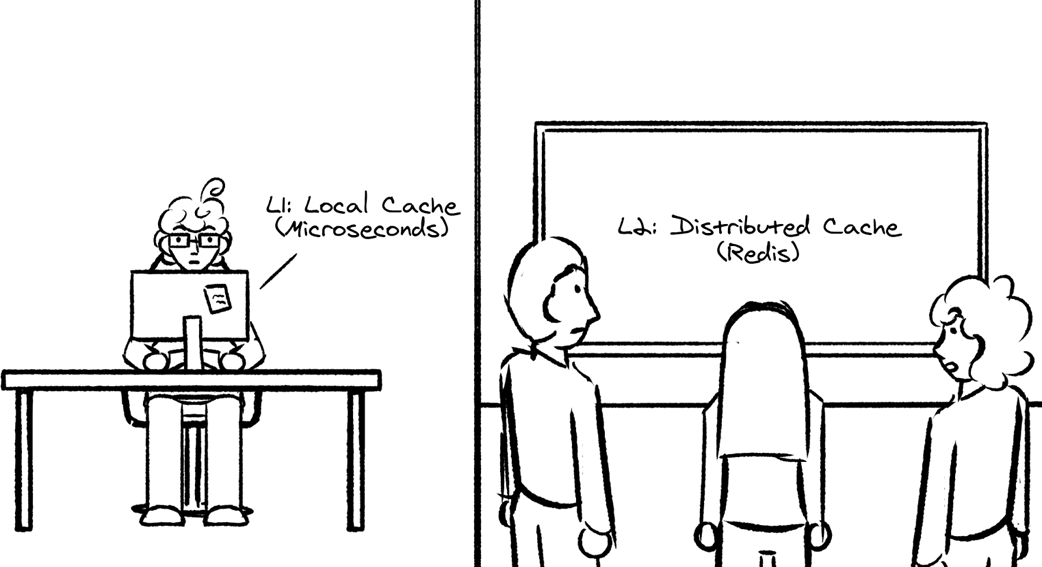
The sticky-note and shared-whiteboard comparison illustrates how local and distributed cache layers differ. section 10.6

