A multifidelity dataset combines objective observations gathered from functions with different costs and accuracies. Each observation includes metadata describing its fidelity, allowing a Gaussian process to use inexpensive, imperfect data alongside costly, accurate evaluations. section 9.2 section 9.7
A practical multifidelity dataset typically records:
- Input features and objective values for observations from high- and low-fidelity functions. section 9.2
- A correlation value identifying how closely each fidelity matches the ground truth; higher values indicate more accurate information. section 9.7
- The fidelity metadata as an additional feature column that a multifidelity Matérn kernel can process. section 9.7
Training a multifidelity GP
Construct train_x_full by appending a fidelity column to the input features, then pass it with train_y to BoTorch’s SingleTaskMultiFidelityGP and specify the fidelity-column index. The trained model can reduce uncertainty around low-fidelity observations while fitting high-fidelity observations appropriately. section 9.2.2 section 9.2.2
Figure 9.3 The multifidelity BayesOpt loop. The GP trains on data from both the high- and low-fidelity functions, and the BayesOpt policy decides where and which function to query at each iteration of the loop.
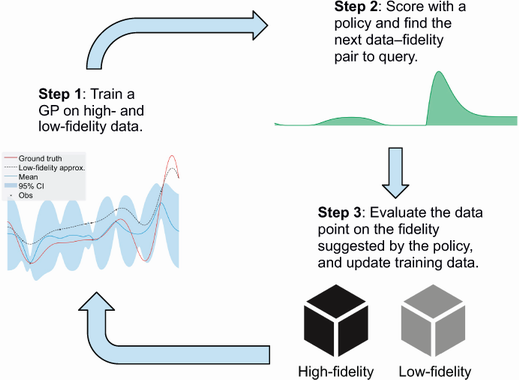
The multifidelity BayesOpt loop shows how a GP trains on observations from both fidelity levels before a policy selects which function and location to query next. section 9.2
