A multiplicative group is a set of elements equipped with multiplication. Its elements and operation satisfy four rules: closure, associativity, an identity element, and an inverse for every element. The identity is written as 1, and multiplying any element a by its inverse a⁻¹ returns 1. section 5.2.1
The four rules keep multiplication inside a predictable mathematical system:
- Closure: multiplying two group elements produces another element in the same set. section 5.2.1
- Associativity: regrouping a(bc) as (ab)c does not change the result. section 5.2.1
- Identity: multiplying a by 1 leaves a unchanged. section 5.2.1
- Inverse: every a has an element a⁻¹, also written 1/a, whose product with a is 1. section 5.2.1
Diffie–Hellman key exchange works in a multiplicative group, making these rules the mathematical foundation for its operations. A concrete setting uses integers modulo a prime, where arithmetic wraps around like a clock; subgroups contain 1 and differ in size. section 5.2.1
Figure 5.4 The four properties of a group: closure, associativity, identity element, and inverse element.
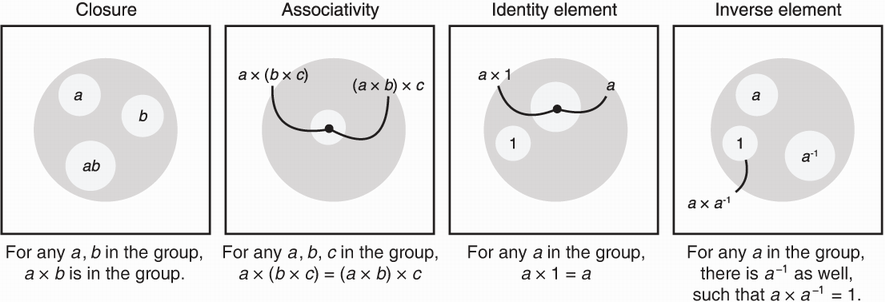
Use the visual summary to compare closure, associativity, identity, and inverse at a glance. section 5.2.1

