liveBook · Manning

Multistage rocket

As explained in Julia as a Second Language

A multistage rocket is a launch vehicle composed of separable propulsion stages that are discarded or exposed sequentially during flight.

A multistage rocket is a launch vehicle assembled from nested rocket stages. As each stage is discarded or opened during flight, the next stage becomes exposed and ultimately delivers the final payload into space. section 8.7

A staged rocket model separates the vehicle into reusable parts:

  • The complete vehicle is the space vehicle; its first stage is the booster. section 8.7
  • A later stage can be represented as the payload of an earlier stage, producing nested rockets. section 8.7

Building three nested stages

Create a Payload with a Curie-powered third stage, place that stage inside a Rutherford-powered second stage, and use a nine-engine Rutherford Cluster for the booster. A recursive mass function then totals the payload, tanks, engines, and nested stages.
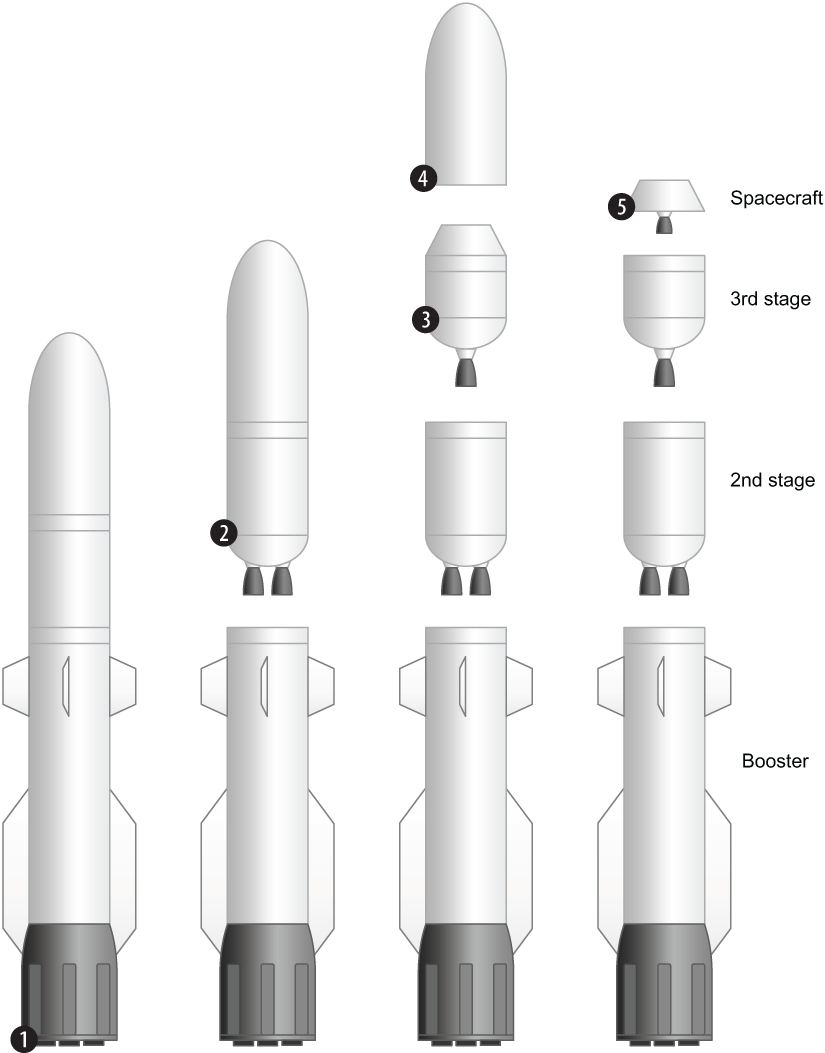
Figure 8.2 Rocket stages
08-02

Use the stage diagram to follow how the booster exposes successive stages and how the final payload is delivered. section 8.7

How Julia as a Second Language covers it

How deep it goes
Builds nested stages, engine clusters, recursive mass, and propellant updates, then extends the model toward launch simulation.
Examples
Uses nested Payload, Curie, Rutherford, tanks, and a nine-engine Cluster to construct and measure a three-stage rocket.
What it assumes
Uses Julia's type definitions, subtypes, fields, methods, and recursive object composition.
What you can do after
Build it from scratch in Julia using nested rocket types, engine clusters, recursive calculations, and update methods.
How it connects
Connects composite types, abstract types, subtyping, payloads, engines, collections, and recursive data structures.

Related concepts

This explainer was generated by Manning's knowledge graph from the text of Julia as a Second Language. The section links point to the parts of the book it draws on.