N-BEATS is a neural forecasting model that learns time-series relationships through stacks of fully connected blocks and basis expansion, without explicit decomposition or input transformations. Its generic architecture makes it useful for exploring pretrained forecasting models and transfer learning. section 2.0 section 2.1 section 2.2
Each block produces a forecast and a backcast. The forecast contributes predicted future values; the backcast reconstructs information learned from the input. Within a stack, later blocks receive residuals after earlier backcasts are subtracted, allowing successive blocks to capture what remains. Stack predictions are then summed into the final forecast. section 2.2.1 section 2.2.2 section 2.2.3
Figure 2.2 Architecture of N-BEATS. N-BEATS consists of stacks of blocks. Each block outputs a forecast and a backcast.
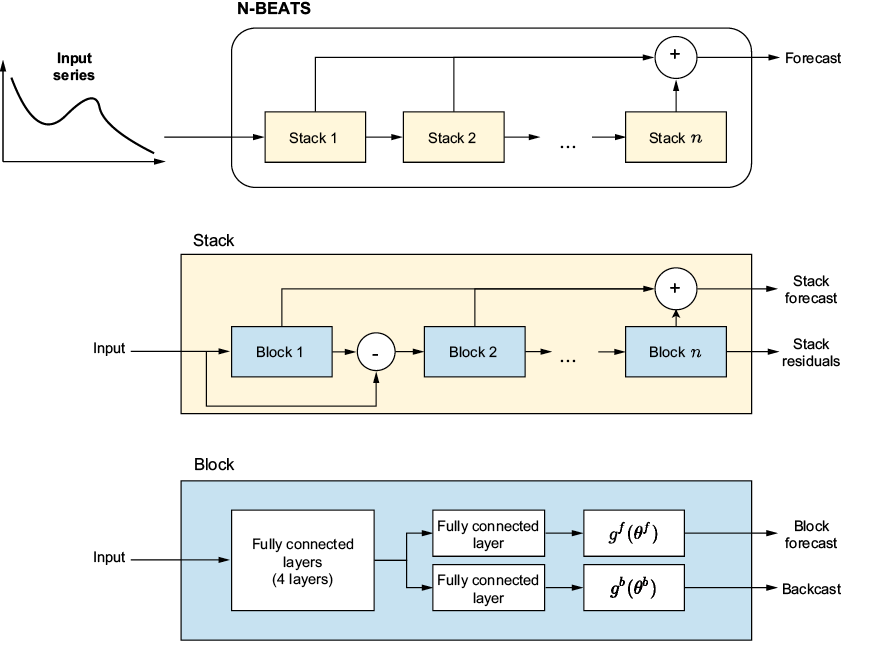
Use the architecture diagram to follow forecast aggregation and residual flow from blocks through stacks. section 2.2
A practical N-BEATS workflow includes:
- Set the forecast horizon and input size, then initialize NBEATS through neuralforecast. section 2.4
- Pretrain with a chosen number of gradient-update steps, and save the resulting model for reuse. section 2.4
- Load the model and perform zero-shot forecasting by passing an unseen dataset without additional training. section 2.5
- Compare pretrained, fine-tuned, and data-specific variants with plots, MAE, and sMAPE. section 2.7
Monthly versus daily forecasting
A model pretrained on monthly M3 data achieved MAE 1.59 and sMAPE 3.56% with zero-shot forecasting on Australian monthly drug prescriptions. Applied unchanged to daily data, it reached MAE 2.59 and sMAPE 8.69%, while a data-specific model reached 1.34 and 4.87%. section 2.7 section 2.8
