3D parallelism combines data parallelism (DP), tensor parallelism (TP), and pipeline parallelism (PP) to distribute LLM training across GPUs. DP increases throughput, TP increases speed, and PP makes training possible when the model does not fit on one device. section 3.3.2 section 3.5
A practical configuration follows the communication and memory trade-offs of each dimension:
- Start with at least eight GPUs, because each of the three dimensions requires at least two GPUs. section 3.3.2
- Place tensor-parallel GPUs close together, preferably within the same node, because TP creates the largest communication overhead. section 3.3.2
- Spread pipeline stages across nodes when necessary, since PP has the lowest communication volume of the three methods. section 3.3.2
- Use microbatching to reduce pipeline bubbles, while accounting for the resulting linear growth in cached activation memory. section 3.3.2
Why the combination helps
TP partitions the model to fit device memory, allowing PP to operate with smaller effective batch sizes. Together, they improve communication between DP nodes and can produce better utilization than any single method alone. section 3.3.2
Figure 3.6 The bubble problem. When data runs through a broken-up model, the GPUs holding the model weights are underutilized while they wait for their counterparts to process the data. A simple way to reduce this bubble is to use microbatching.
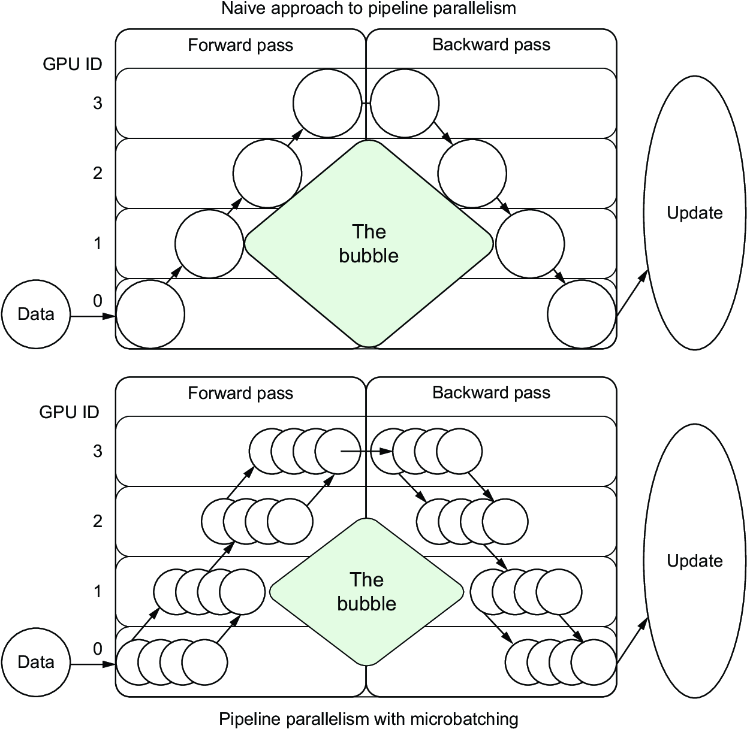
Use the pipeline-bubble diagram to see why GPUs can remain underutilized while stages wait, and how microbatching reduces that idle time. section 3.3.2

