liveBook · Manning

N×M integration problem

As explained in Building Reliable AI Systems

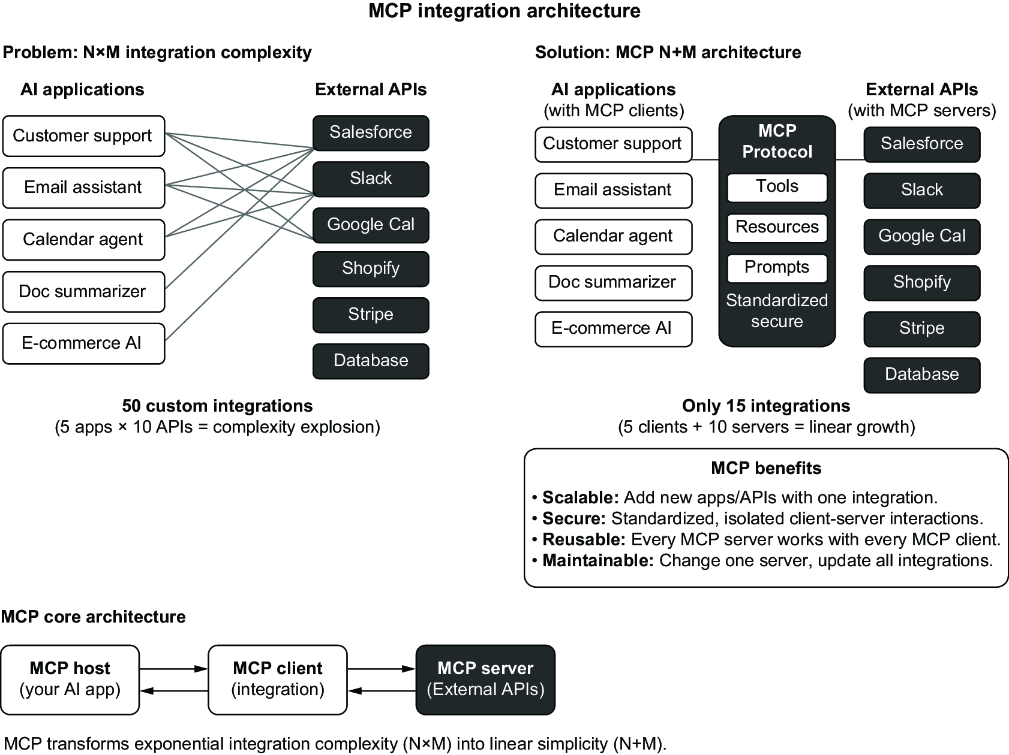
The N×M integration challenge is the scaling problem in which integrating N AI applications with M external systems requires a separate custom integration for each pairing.

When each AI application connects to each external system through custom code, every new app or API adds more one-off integrations to build and maintain. Those connections can fail independently, and a change may require refactoring across them. Model Context Protocol (MCP) is introduced as a standardized alternative. section 7.0 section 7.1

Five applications, ten APIs

If five AI applications each need ten APIs, individual integrations require 50 custom connections. The example applications include support, email, scheduling, document summarization, and e-commerce; APIs include Salesforce, Slack, calendars, payment services, and databases. section 7.2

Figure 7.1 Without MCP (left), each application must integrate individually with each external API, creating N×M integrations. On the right, the MCP architecture shows the scalability benefits of standardized client-server interactions.
figure

Compare the many direct app-to-API connections with the standardized client-server arrangement. section 7.2

How Building Reliable AI Systems covers it

How deep it goes
Quantifies integration growth with a five-app, ten-API example and notes change-driven refactoring, without detailing a migration procedure.
Examples
Uses five AI applications and ten APIs to illustrate 50 custom integrations, naming support, email, scheduling, and payment examples.
What you can do after
Understand how adding applications and APIs multiplies custom connections and why standardized MCP interfaces change that scaling pattern.
How it connects
Links AI applications and external APIs through custom integrations, then contrasts that pattern with Model Context Protocol (MCP).

Related concepts

This explainer was generated by Manning's knowledge graph from the text of Building Reliable AI Systems. The section links point to the parts of the book it draws on.