A named argument, also called a keyword argument, supplies a value by naming the corresponding parameter. Unlike positional arguments, keyword arguments do not depend on their order. section 6.4.1
Call a function with named arguments
For a function such as `def multiply_numbers(a, b): return a * b`, these calls produce the same result: `multiply_numbers(2, 3)` and `multiply_numbers(a=2, b=3)`. Reordering the names remains valid: `multiply_numbers(b=3, a=2)`. When combining styles, place positional arguments first: `multiply_numbers(2, b=3)`. section 6.4.1
Use named arguments to make function calls clearer and to handle flexible interfaces:
- Match values to parameters by identifier rather than by position. section 6.4.1
- Keep positional arguments before named arguments; otherwise Python raises a `SyntaxError`. section 6.4.1
- Accept an arbitrary number of named arguments with `**kwargs`; Python collects them into a dictionary. section 6.4.3
- Use valid identifiers for keyword names; names cannot begin with a number. section 6.4.5
Figure 6.6 Using positional and keyword arguments in function calls. If the arguments have identifiers preceding the arguments, they’re keyword arguments. If the arguments have no identifiers, they’re positional arguments.
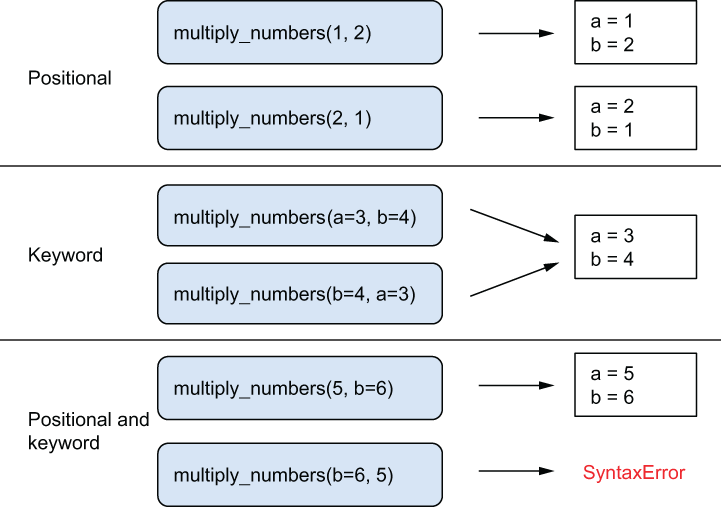
Compare positional and named arguments visually through representative function calls. section 6.4.1


