Natural language autocomplete suggests search completions by meaning and context, not only literal character or keyword matches. A Transformer encodes a concept dictionary into embeddings; an approximate nearest-neighbor index retrieves concepts similar to the user’s prefix or term and ranks them by similarity. section 13.4 section 13.5
Figure 13.5 A conceptual architecture for end-to-end search using Transformer-encoded vectors
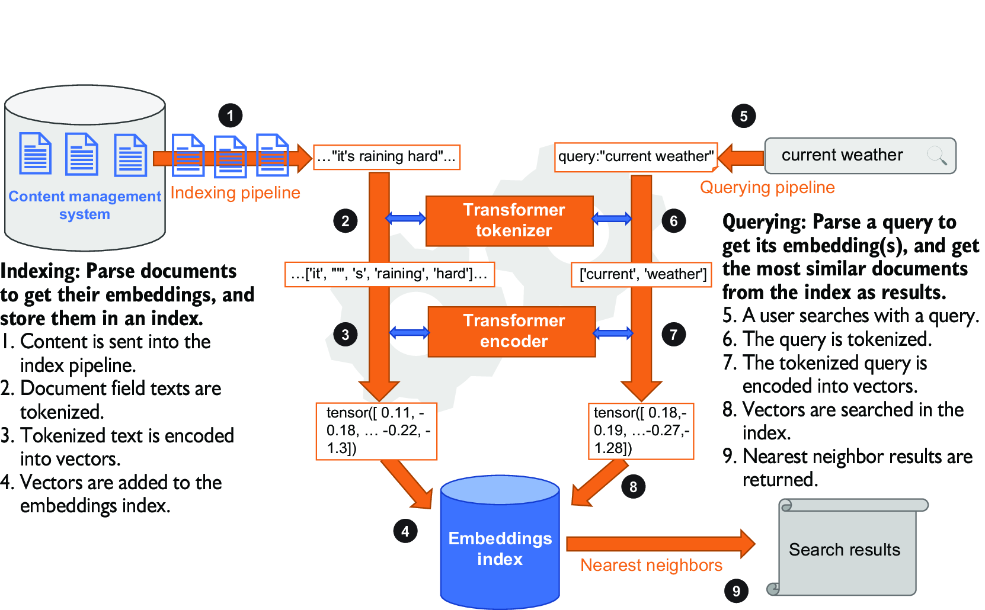
Use the architecture to follow content extraction, vector encoding, indexing, query encoding, nearest-neighbor retrieval, and ranked presentation as one search pipeline. section 13.4
A practical implementation proceeds through these stages:
- Extract candidate concepts from search content; the example uses spaCy to chunk nouns and verbs from an outdoors dataset. section 13.5
- Encode the concepts with a sentence Transformer and store their vectors in an approximate nearest-neighbor index. section 13.5
- Encode each incoming prefix or term on demand, retrieve the k-nearest concepts, and return suggestions above a similarity threshold. section 13.5.4
- Tune the threshold against real user queries, measure throughput, and validate quality with labeled data before deployment. section 13.5.4
Meaning-based suggestions
A query such as "mountain hike" returns "mountain hiking" at 0.975, followed by related concepts such as "mountain trail" and "winter hike". Even the incomplete term "dehyd" produces "dehydrate", "dehydration", "rehydration", and "hydration pack". The implementation uses a default minimum similarity of 0.75, with a fallback when no result meets the threshold. section 13.5.4
