A negative gradient points in the direction that reduces a loss. In gradient boosting, it identifies how the current model should change rather than merely measuring whether predictions are wrong. section 5.2.1
Use the negative gradient to guide each sequential update:
- Compute the loss derivative for each training example. section 7.3
- Treat the negative gradients as residuals: large values mark examples requiring more attention, while small values indicate closer predictions. section 5.2.1
- Train a weak regressor to approximate those residuals, then add its prediction to the current model. section 5.2.1 section 7.3
Squared-loss example
With squared loss, the negative gradient is exactly the residual between the true label and the prediction. A large gap produces a large update signal; a small gap produces a small one. section 5.2.1
Figure 5.9 Comparing gradient descent (left) to gradient boosting (right). At iteration t, gradient descent updates the model using the negative gradient, -gt. At iteration t, gradient boosting approximates the negative gradient by training a weak regressor, ht, on the negative residuals -rti. The step length αt in gradient descent is equivalent to the hypothesis weight of each base estimator in a sequential ensemble.
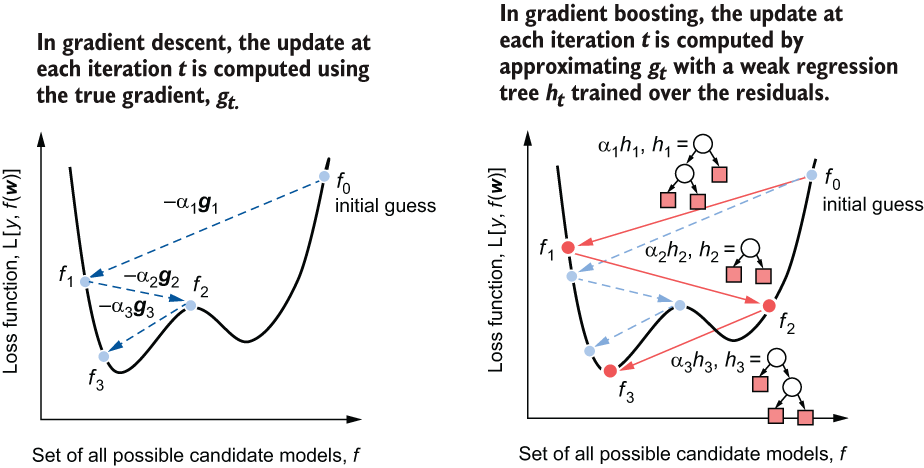
Compare ordinary gradient descent, which uses the exact negative gradient, with gradient boosting, which approximates it using a weak regression tree. section 5.2.1
