Negative log-likelihood turns a probabilistic model’s assigned likelihood into an optimization target. It connects the chosen residual distribution to the loss and therefore to the model’s behavior. section 7.3.1
Choose the distribution that matches the target and residual behavior:
- Gaussian residuals produce squared error, which heavily penalizes large errors and remains suitable for gradient and Newton boosting. section 7.3.1
- Laplacian residuals produce absolute error, reducing the influence of extreme errors but lacking the second derivative required for Newton boosting. section 7.3.1
- Huber loss combines squared-error behavior for small residuals with scaled absolute-error behavior beyond a chosen threshold. section 7.3.1
Comparing residual assumptions
For a continuous target, selecting Gaussian residuals emphasizes large mistakes through squared error; selecting Laplacian residuals treats extreme mistakes less aggressively through absolute error. section 7.3.1
Figure 7.10 Loss and log-likelihood functions for three different types of targets: continuous-valued (left), positive continuous-valued (center), and count-valued (right)
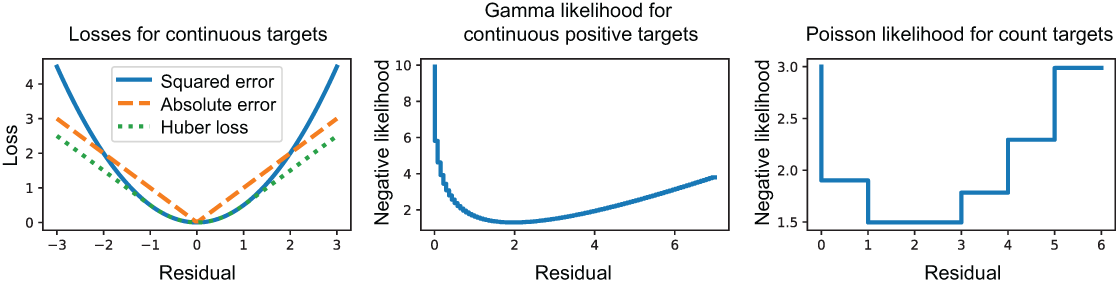
Compare loss and log-likelihood shapes for continuous, positive continuous, and count-valued targets. section 7.3.1






