Agent state is a structured record that carries information between agents and accumulates intermediate results throughout a LangGraph question-answering workflow. section 15.1.5
The state coordinates a staged pipeline by storing:
- Visualization intent, including output type and the reason for selecting a table, graph, or map. section 15.1.5
- Knowledge-graph schema information, generated Cypher, query reasoning, and serialized query messages. section 15.1.5
- Execution results, errors, retry counts, routing information, summaries, and summary reasoning. section 15.1.5
State-driven QA pipeline
Intent detection enriches the record, schema extraction adds a Neo4j schema, text-to-Cypher generates a query, and query execution records errors and increments retries. Routing then retries failed queries up to three runs, summarizes graph or map results, or ends directly for other output types. section 15.1.5
Figure 15.7 LangGraph implementation of the knowledge expert-emulating graph-querying pipeline
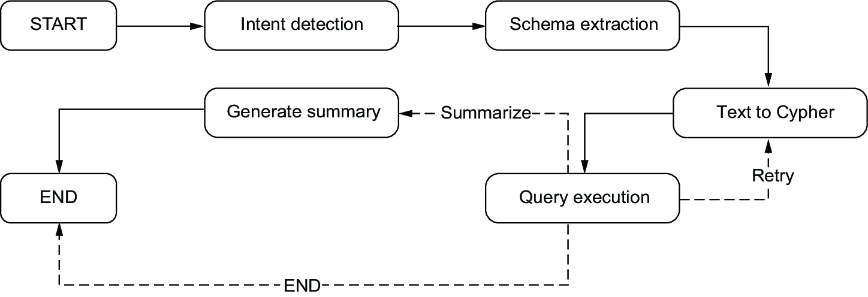
Trace how agents connect and how state information progresses from the user’s question to the final answer. section 15.1.5
