An annotation records an assertion connecting a disease with a phenotypic feature, together with descriptive metadata such as source, author, and creation date. In a knowledge graph, this metadata supports provenance tracking and can be attached to the relationship itself. section 3.2.1 section 3.2.2
Choose the representation according to how the graph will be queried and maintained:
- RDF n-ary relations create an annotation resource, often a blank node, that links the disease and phenotypic feature to source, author, and creation date. section 3.2.2
- RDF named graphs keep the disease–feature statement in a graph and associate annotation metadata with that named graph. section 3.2.2
- RDF-star attaches metadata directly to the quoted relationship, while LPG stores the same properties on the edge. section 3.2.2
Biomedical annotation
An annotation can connect OMIM:222100, insulin-dependent diabetes mellitus, with HP:0410050, decreased serum 1,5-anhydroglucitol. Its metadata records PMID:9357814, Nicole Vasilevsky, and 2018-02-23. An LPG query matches the disease and feature, then returns the edge’s source, creator, and creation date. section 3.2.1 section 3.2.2
Figure 3.6 Data transformation from a table row to a KG edge. Information in the table is adapted to define the properties of nodes and edges in the KG.
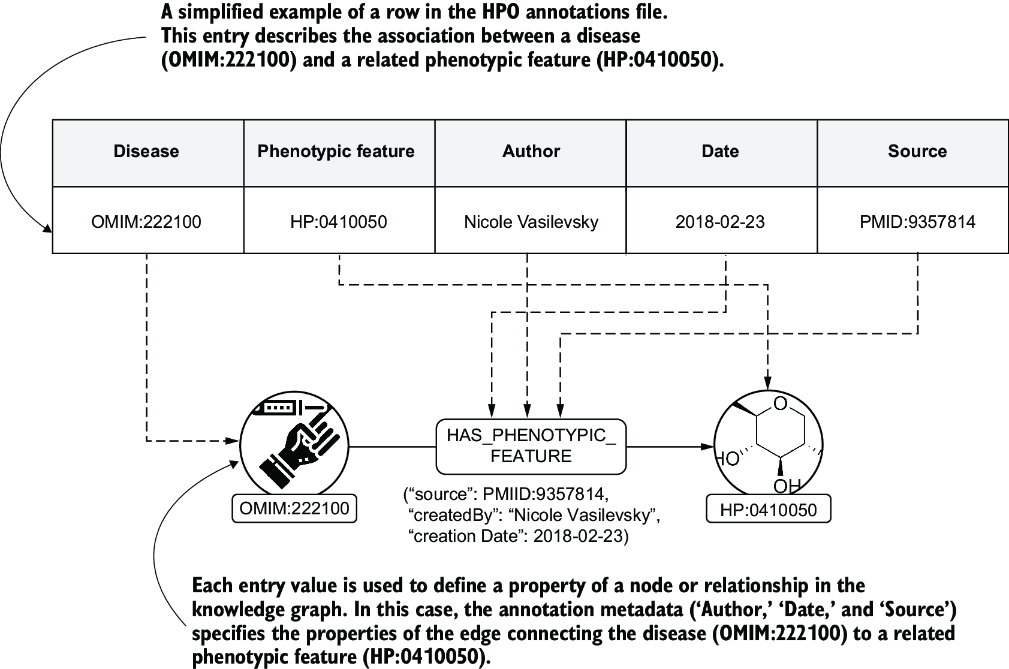
Shows how a tabular annotation row becomes a knowledge-graph edge whose endpoints are nodes and whose provenance fields are edge properties. section 3.2.1
