When a promotion has a cost, the practical question is not who will respond, but who will respond favorably because of the intervention. A persuadable is a person who would experience the favorable outcome if the promotion or treatment were applied, but the unfavorable outcome otherwise. section 8.3.3
Counterfactual segmentation contrasts persuadables with three other response types:
- Lost causes experience the unfavorable outcome with or without the promotion. section 8.3.3
- Sure things experience the favorable outcome with or without the promotion. section 8.3.3
- Sleeping dogs would experience the favorable outcome without the promotion but the unfavorable outcome after receiving it. section 8.3.3
Churn-prevention promotion
For a subscriber, the favorable outcome is staying with the service and the unfavorable outcome is churning. A persuadable stays when offered a promotion but churns without it, making the subscriber a candidate for targeted intervention. section 8.3.3
Figure 8.5 In attempts to influence behavior, we break down the target population into these four segments. Given limited resources, we want to target our influence efforts on the persuadables and avoid the others, especially the sleeping dogs.
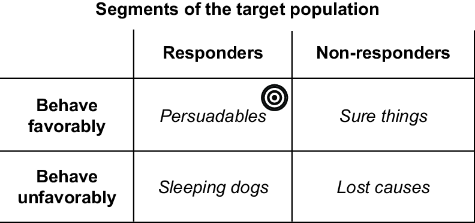
Use the population-segmentation figure to compare persuadables with sure things, lost causes, and sleeping dogs when allocating limited promotional resources. section 8.3.3
