A sure thing is a person who will experience the favorable outcome whether or not an intervention is applied. In promotion targeting, this is a subscriber who will stay with the service with or without a promotion. section 8.3.3
The distinction is causal rather than predictive: a sure thing may have a high probability of staying, but the promotion does not change that outcome. Spending an incentive on this group creates cost without incremental benefit. section 8.3.3
Binary counterfactual segmentation contrasts sure things with:
- Persuadables, who stay because the promotion changes their decision. section 8.3.3
- Lost causes, who churn regardless of the promotion. section 8.3.3
- Sleeping dogs, whose outcome becomes worse when the promotion is applied. section 8.3.3
Figure 8.5 In attempts to influence behavior, we break down the target population into these four segments. Given limited resources, we want to target our influence efforts on the persuadables and avoid the others, especially the sleeping dogs.
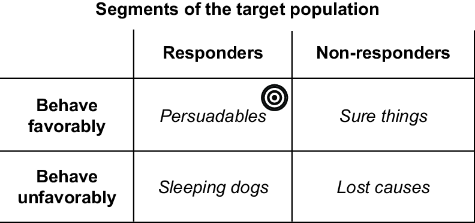
Use the population segmentation to compare sure things with persuadables, lost causes, and sleeping dogs when allocating limited influence efforts. section 8.3.3
