A nested tuple is a tuple containing another tuple as one of its elements. Tuples can hold any kind of object, including several levels of subordinate tuples. section 10.2 section 10.3
Index through the levels
Consider (3, (3, ("5", 7), 9), "a"). The expression [1] selects (3, ("5", 7), 9); the next [1] selects ("5", 7); the final [1] selects 7. Therefore, (3, (3, ("5", 7), 9), "a")[1][1][1] evaluates to 7. section 10.2
When working with nested tuples:
- Use indexing from position 0, remembering that an index may return another tuple rather than a final value. section 10.2
- Chain indexing operations to reach values deeper inside the structure. section 10.2
- Use slicing to select a range of outer elements, while checking whether those elements are themselves tuples. section 10.2
- Organize related results as a tuple of tuples, such as separate tuples for names and phone numbers read from a file. section 23.1
A practical data shape
A file-reading function can return ((Friend1 Name, Friend2 Name, ...), (Friend1 phone, Friend2 phone, ...)). The outer tuple returns both collections as one value, while each inner tuple stores one kind of information. section 23.1
Figure 10.1. The structure of the tuple (3, (3, ("5", 7), 9), "a"). The dashed lines indicate separate objects in the tuple.
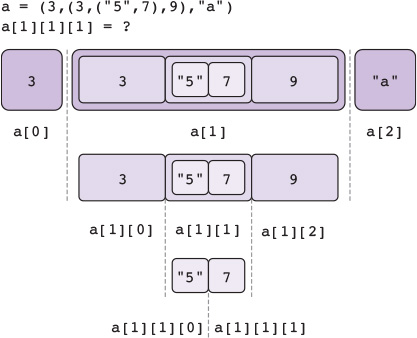
Use the structure diagram to see each nested tuple as a separate object and trace the path taken by chained indexing. section 10.2

