liveBook · Manning

Network access layer

As explained in Rust Servers, Services, and Apps

The network access layer is the lowest layer of the TCP/IP model, responsible for transmitting data over physical links between hosts.

The network access layer is the lowest layer of the TCP/IP model. It transmits data over physical links between hosts and supports the layers above it. section 2.1

Use its position to orient the communication stack:

  • It sits beneath the network, transport, and application layers. section 2.1
  • It belongs to a flexible set of standards and protocols rather than defining one protocol for every network. section 2.1
  • Higher layers provide internet delivery, reliable byte streams, and application semantics such as HTTP. section 2.4
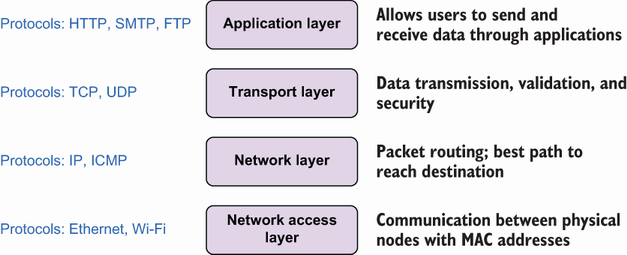
Figure 2.1 TCP/IP network model

Use the TCP/IP network model diagram to trace the network access layer’s position beneath the other communication layers. section 2.1

How Rust Servers, Services, and Apps covers it

How deep it goes
Places the layer at the bottom of the TCP/IP stack but does not detail its protocols or implementation.
Examples
Uses Figure 2.1 to visualize the network access layer within the TCP/IP network model.
What you can do after
Understand how the network access layer fits beneath TCP-based web communication and application protocols such as HTTP.
How it connects
Connects network access with the network, transport, and application layers in the TCP/IP model.

This explainer was generated by Manning's knowledge graph from the text of Rust Servers, Services, and Apps. The section links point to the parts of the book it draws on.