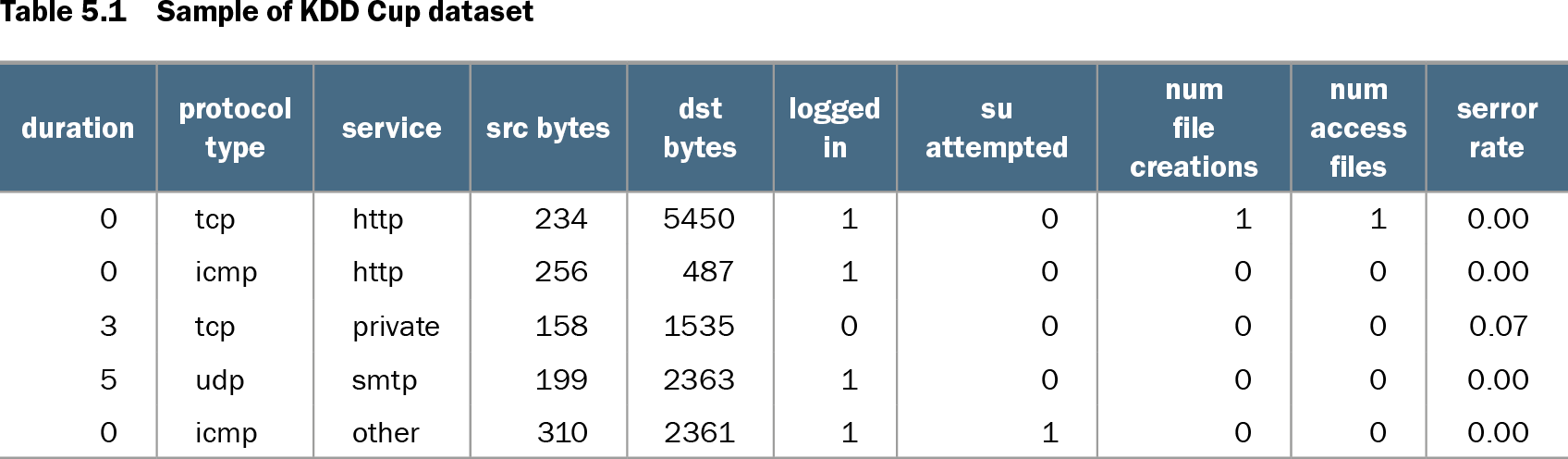
A network attack is a nonnormal pattern of network use treated as an outlier or binary-classification target. Connection records may describe protocol, service, byte counts, login activity, file operations, and error rates. section 5.2.1
Common attack forms represented in the data include:
- Smurf attacks section 5.2.1
- Port sweeps section 5.2.1
- Buffer overflows section 5.2.1
KDD Cup connection records
The KDD Cup dataset labels each row as normal or an attack type. Its extreme imbalance—about 99.7% normal rows—supports evaluating detectors against rare attacks, while warning that detector performance depends on the data type. section 5.2.1
Table 5.1 Sample of KDD Cup dataset (view table figure)
| duration |
protocol type |
service |
src bytes |
dst bytes |
logged in |
su attempted |
num file creations |
num access files |
serror rate |
|---|---|---|---|---|---|---|---|---|---|
| 0 |
tcp |
http |
234 |
5450 |
1 |
0 |
1 |
1 |
0.00 |
| 0 |
icmp |
http |
256 |
487 |
1 |
0 |
0 |
0 |
0.00 |
| 3 |
tcp |
private |
158 |
1535 |
0 |
0 |
0 |
0 |
0.07 |
| 5 |
udp |
smtp |
199 |
2363 |
1 |
0 |
0 |
0 |
0.00 |
| 0 |
icmp |
other |
310 |
2361 |
1 |
1 |
0 |
0 |
0.00 |
Inspect sample connection records containing duration, protocol, service, byte counts, login status, file operations, and SYN-error rate. section 5.2.1