Network projection turns an indirect pattern in a multipartite graph into direct relationships among one chosen node type. A common case starts with a bipartite graph: tweets connect to hashtags, and two tweets can be connected because they share a hashtag. The result is a monopartite network containing one node type and one relationship type. section 2.4.2 section 2.4.4
Choose the node type that fits the question. Projecting tweets through shared hashtags can create SIMILAR relationships between tweets; projecting hashtags through shared tweets can instead connect hashtags that co-occur. The inferred relationship should be named for its domain meaning, not merely for the path used to derive it. section 2.4.2
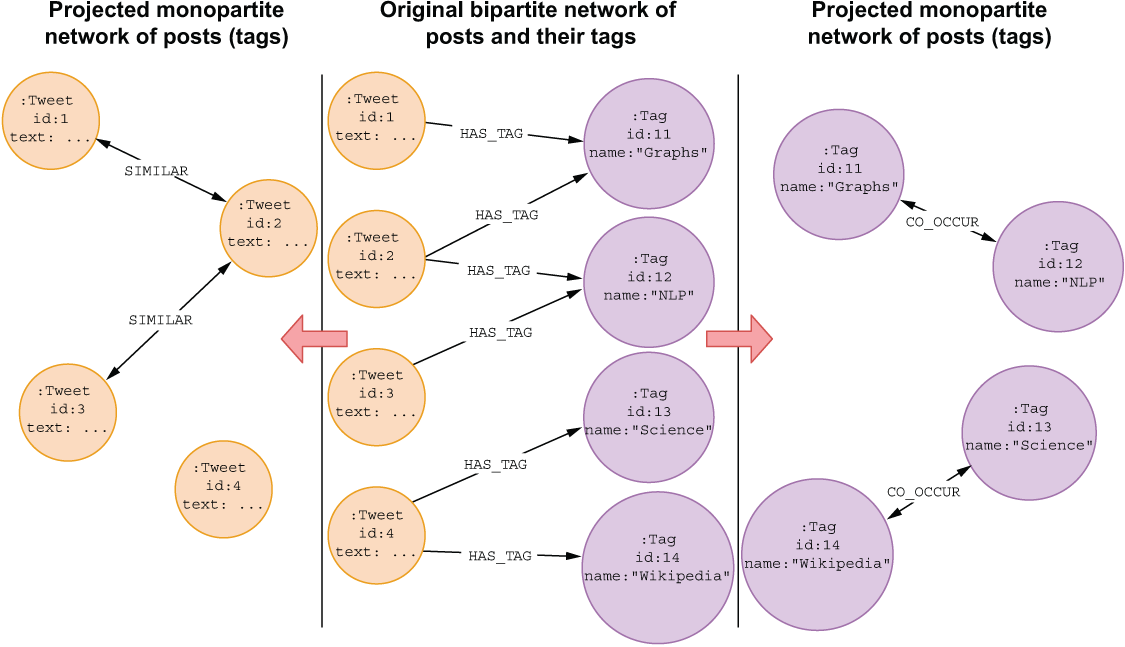
Use this diagram to trace how a Tweet–Tag–Tweet pattern becomes a direct Tweet–SIMILAR–Tweet relationship. section 2.4.2
Projection is useful when an analysis needs a simpler network because:
- Most classical graph algorithms, including centrality and community detection, are designed for monopartite networks. section 2.4.2
- It makes an implicit connection explicit, allowing an analyst to work directly with the relationship of interest. section 2.4.4
- It reduces a graph with several node and relationship types to a selected network for a focused question. section 6.0
Projecting content amplification
A retweet pattern can be projected into a User network. Match a user who publishes a tweet that retweets another tweet published by a second user, then create an AMPLIFY relationship from the sharing user to the original content creator. This direct network supports analysis of influential content creators, where both the number of retweets and the audience of the users doing the retweeting can matter. section 6.0 section 6.0
Projection is an analytical transformation, so inferred relationships need not be part of the initial schema. Keep the original graph model available, decide which indirect pattern answers the question, and instantiate only the projected relationships needed for the analysis. section 2.4.4 section 2.5
