Network segmentation divides a larger network into smaller, isolated parts. Each segment can have its own access controls and security policies. Systems with similar jobs or risk levels can be grouped together, making it harder for an attacker who compromises one part of the network to reach others. section 11.8
Segmentation can also improve performance. Broadcast traffic—data sent to every device on the same network—stays within a smaller area. Separating financial systems from web servers, for example, can keep heavy web traffic from slowing critical financial work. section 11.8
Common approaches provide different levels of separation:
- Physical segmentation uses separate network hardware. Virtual, or logical, segmentation uses configuration on existing devices instead. section 11.8.2
- Virtual local area networks (VLANs) create separate logical networks on shared physical infrastructure. Switches assign devices to VLANs, so devices in different locations can belong to the same segment. section 11.8.2
- Subnetting separates networks through IP addressing and routing. Micro-segmentation goes further, restricting communication between individual devices, workloads, or applications—even within one VLAN or subnet. section 11.8.4
Keep sensitive systems apart
A company can use internal firewall rules to separate accounting systems from employee workstations. If a workstation is compromised, those rules make it harder for the attacker to move laterally into financial systems. Wireless and IoT devices can likewise be placed apart from critical business systems to limit their exposure. section 12.5.1 section 12.7.2
Figure 11.14 Network topology diagram showing segmented VLANs spanning distinct physical spaces
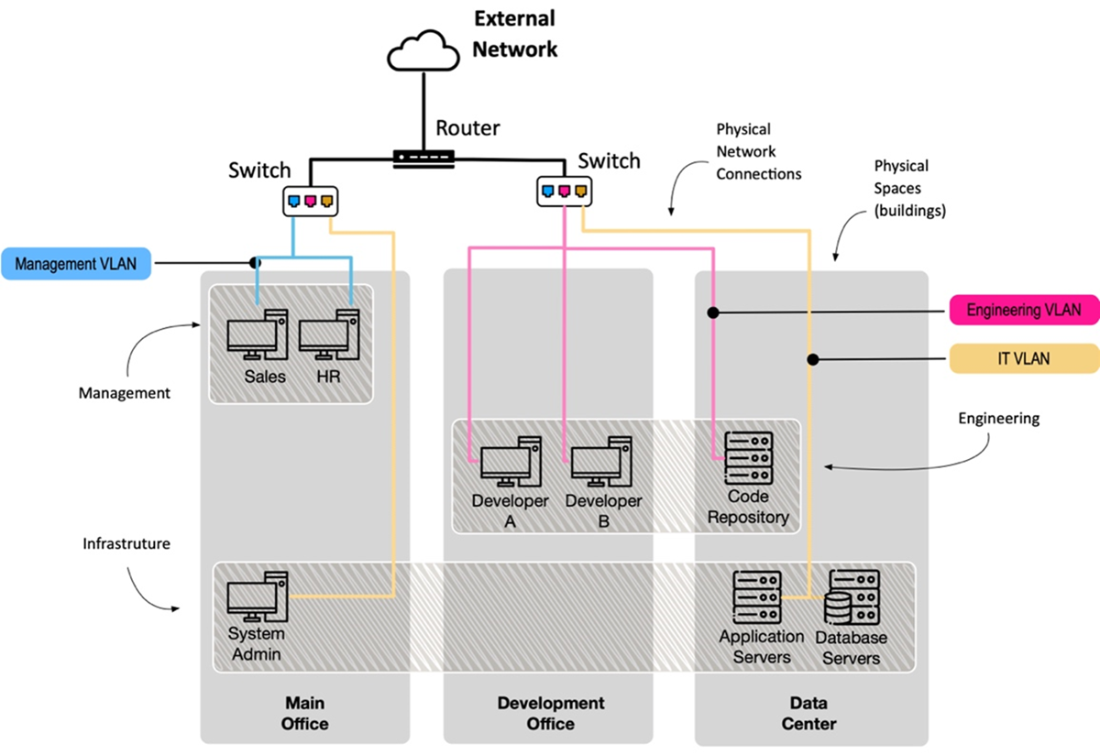
The diagram shows management, engineering, and IT VLANs spanning different physical spaces. Devices need not sit together to share a logical segment. section 11.8.2
|
|
Physical segmentation
|
VLANs
|
Subnetting
|
Micro-Segmentation
|
|
OSI Layer
|
Physical
(Layer 1)
|
Data Link
(Layer 2)
|
Network
(Layer 3)
|
Application
(Layers 4–7)
|
|
Technology Base
|
Separate
cabling, switches, routers
|
Switch
configuration using VLAN IDs
|
IP
addressing, routing, Layer 3 boundaries
|
Software-Defined
Networking (SDN), host-based firewalls
|
|
Granularity
|
Device or
network level
|
VLAN or switch
port level
|
Subnet level
|
Individual
workload, application, device, or user
|
|
Isolation
|
Complete
(physically disconnected)
|
Logical layer
2 (messages need Layer 3 to cross)
|
Logical layer
3 (messages needs router to cross)
|
Granular
(defined by policy; not topology)
|
|
Security Control
|
Air gapping
or dedicated hardware firewalls
|
VLAN ACLs,
port security, switch policies
|
ACLs,
routing policies, Layer 3 firewalls
|
Zero Trust
policies, application-aware filtering, workload-level controls
|
|
Flexibility
|
Very low
(hardware changes needed)
|
Medium (can
reassign ports to VLANs)
|
Low (IP
readdressing required)
|
Very high
(policies can be updated dynamically)
|
|
Use Cases
|
Highly
secure or sensitive industrial control systems
|
Departmental
segmentation (e.g., HR, Finance, IT)
|
Traditional
enterprise networks
|
Modern data
centers, Cloud environments, Zero Trust architectures
|
Compare physical segmentation, VLANs, subnetting, and micro-segmentation by their technology, granularity, isolation, and security controls. section 11.8.4