liveBook · Manning

Network stack

As explained in Rust Servers, Services, and Apps

A layered collection of networking protocols and supporting implementations that enables communication between distributed system components.

A network stack is the networking layer within a distributed system, connecting distributed application components across servers. It supports communication between workloads running on separate machines while sitting alongside applications and hardware and OS infrastructure. section 1.1

A modern web application uses the stack in this way:

  • Distributed applications communicate internally through a range of networking protocols. section 1.1
  • HTTP commonly serves as the application-layer protocol for communication with the outside world because it is simple and universal. section 1.1
  • Servers may connect within one data center or across geographically distributed cloud infrastructure. section 1.1
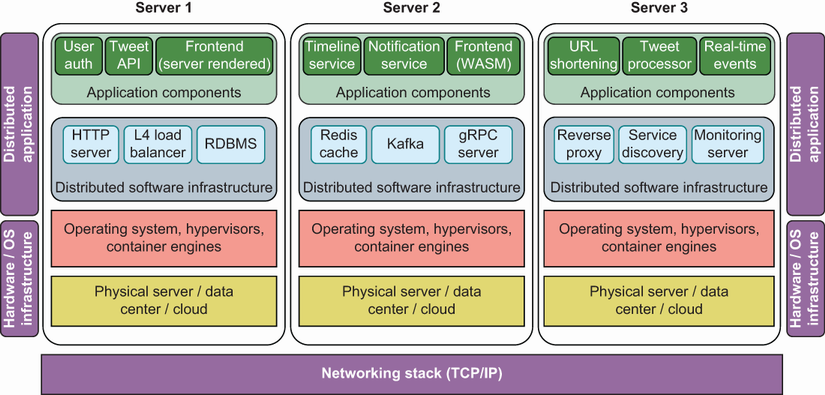
Figure 1.1 A simplified distributed systems stack for a social media application

Use the simplified distributed-systems diagram to trace how application components, servers, and the networking stack fit together. section 1.1


How Rust Servers, Services, and Apps covers it

How deep it goes
Defines the stack within a distributed-systems model and identifies HTTP as an application-layer protocol, but does not detail lower layers.
Examples
Uses distributed web applications such as social media, e-commerce, sharing-economy, entertainment, and cloud applications.
What you can do after
Evaluate/understand how distributed web applications place HTTP and server communication within a broader systems stack.
How it connects
Ties distributed applications and HTTP to hardware and OS infrastructure within distributed systems.

Also explained in

Compare how 2 books explain network stack →

Related concepts

This explainer was generated by Manning's knowledge graph from the text of Rust Servers, Services, and Apps. The section links point to the parts of the book it draws on.