liveBook · Manning

Networking model

As explained in Rust Servers, Services, and Apps

A networking model is an abstract framework that describes how messages are communicated between senders and receivers across a network.

A networking model describes how messages move between senders and receivers across a network. It frames communication between browsers, mobile apps, backend services, and infrastructure such as databases. section 2.1

It addresses message formats, byte-level transmission, and handling failures when packets do not reach their destination. The OSI model provides seven layers; internet communication is often described with the simpler four-layer TCP/IP model. section 2.1

The TCP/IP model organizes communication into four abstract layers:

Client request to backend

A web browser or mobile app sends a request to a backend service, while backend services communicate with supporting infrastructure such as databases. The layers complement one another to deliver the message to its receiving process. section 2.1
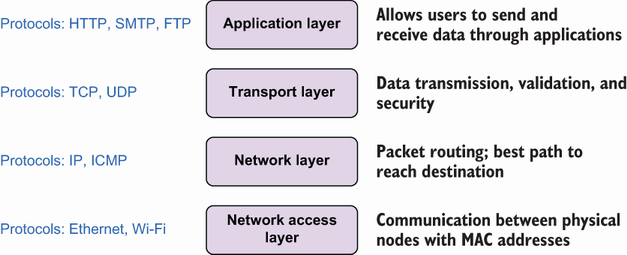
Figure 2.1 TCP/IP network model

Use the TCP/IP model diagram to see the four abstract layers together. section 2.1

How Rust Servers, Services, and Apps covers it

How deep it goes
Defines message communication and outlines four TCP/IP layers, while stopping short of detailed layer-by-layer implementation.
Examples
Uses browser-to-backend and backend-to-database communication as concrete examples, supported by a TCP/IP layer diagram.
What it assumes
Assumes familiarity with clients, backend services, and distributed components while introducing the networking model from its communication problem.
What you can do after
Evaluate how internet messages move between client and server processes using the TCP/IP layer structure.
How it connects
Connects clients, backend services, databases, OSI, TCP, IP, and distributed software infrastructure.

Also explained in

Compare how 2 books explain networking model →

Related concepts

This explainer was generated by Manning's knowledge graph from the text of Rust Servers, Services, and Apps. The section links point to the parts of the book it draws on.
