Newcomb’s paradox tests whether a decision-maker should maximize the causal consequences of an action or account for a highly accurate prediction of that action. Box A contains $1,000; box B contains either $0 or $1,000,000. The agent chooses box B alone or both boxes. Causal reasoning favors both boxes because the choice cannot change box B’s contents, while prediction-aware reasoning favors box B alone because the agent’s intention is associated with what the predictor placed there. section 12.2.5
With a predictor that is 95% accurate, the possible outcomes are:
- Choosing both boxes yields $1,000 with probability .95 and $1,001,000 with probability .05, for expected utility of $51,000. section 12.2.5
- Choosing only box B yields $1,000,000 with probability .95 and $0 with probability .05, for expected utility of $950,000. section 12.2.5
- The dilemma separates intervention-based evaluation, E(U | choice = x), from evaluation conditional on intent, E(U | choice = x, intent = i). section 12.2.6
A causal model of the decision
Represent intent as causing both the AI’s prediction and the eventual choice; let the prediction determine box B’s contents, and let choice and box B determine utility. In pgmpy, define this Bayesian network with causal Markov kernels, then intervene on choice and condition on intent. The resulting values are 51,000 versus 50,000 when intent initially favors both boxes, and 951,000 versus 950,000 when intent favors box B, making the best final choice depend on the initial intent. section 12.2.6
Table 12.1 Newcomb’s problem outcomes and their probabilities
|
Strategy
|
AI action
|
Winnings
|
Probability
|
|---|---|---|---|
|
Choose both
|
Put $0 in box B
|
$1,000
|
.95
|
|
Choose both
|
Put $1,000,000 in box B
|
$1,001,000
|
.05
|
|
Choose only box B
|
Put $1,000,000 in box B
|
$1,000,000
|
.95
|
|
Choose only box B
|
Put $0 in box B
|
$0
|
.05
|
Compare each strategy’s AI prediction, winnings, probability, and expected utility in one table. section 12.2.5
Figure 12.9 A better causal DAG representing the framing of Newcomb’s paradox
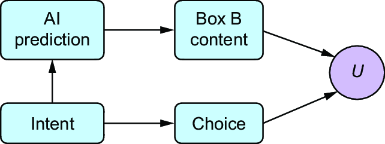
Inspect the causal DAG that treats intent, rather than the later choice alone, as the source of the AI prediction. section 12.2.6
