A node embedding technique learns a compact vector for each graph node instead of feeding the entire adjacency matrix into a model. The vectors encode structural or relational properties, so nearby points in embedding space represent nodes with similar neighborhood topology. section 9.0
The embedding step is unsupervised: it learns representations without labeled training data. Models use deep learning and nonlinear dimensionality reduction, while the embedding dimension controls the number of elements in each vector. section 9.0
Node embeddings address practical limitations of adjacency-matrix features:
- Reduce the number of input features and limit overfitting risk. section 9.0
- Keep the representation size stable when nodes are added or removed. section 9.0
- Replace painstaking manual feature engineering with a learned representation. section 9.0
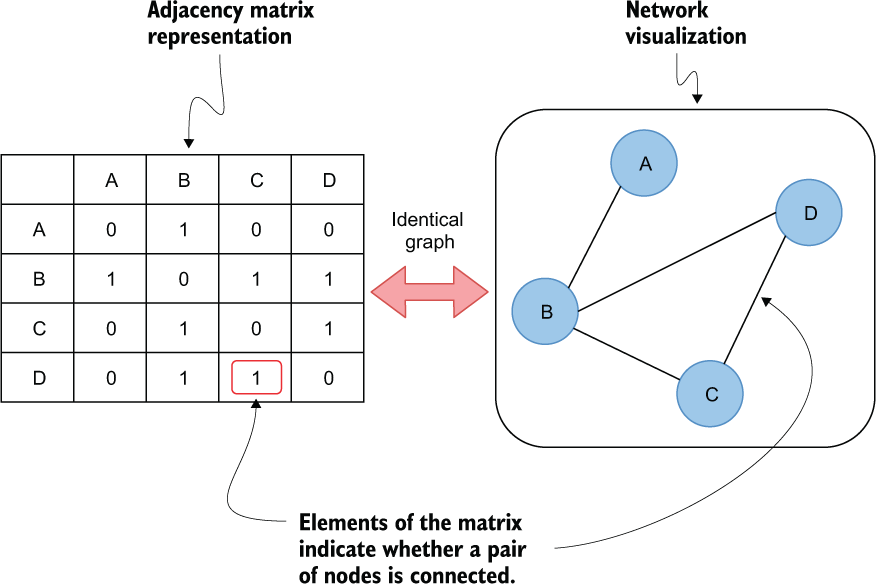
Use the adjacency matrix illustration to see the high-dimensional input that node embeddings compress. section 9.0
