liveBook · Manning

Noise addition

As explained in Machine Learning System Design

The deliberate perturbation of data values with random noise to assess or improve the stability of model decisions.

Noise addition perturbs sample values to test how stable threshold-dependent metrics are. Small random changes can shift precision and recall, revealing a narrow, fragile decision-boundary margin. section 7.4

Treat noise level as a hyperparameter and combine perturbation with Poisson bootstrap to estimate confidence bounds for recall at a given precision or specificity. section 7.4

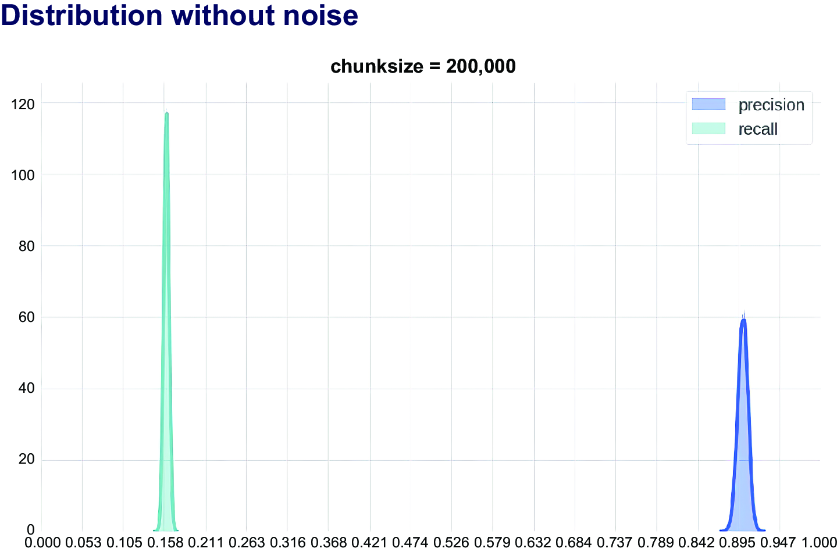
Distribution of precision and recall with sample size of 200;000; every point is a bootstrapped original dataset, no noise added.
sidebar figure

Compare the bootstrapped precision and recall distributions without added noise against the perturbed results. section 7.4

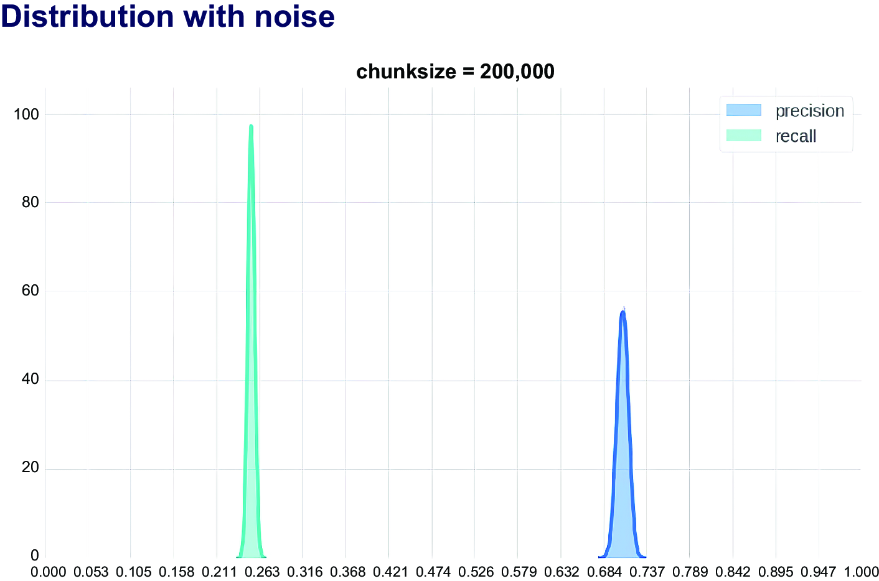
Distribution of precision and recall with a sample size of 200,000; every point is a bootstrapped original dataset, noise added.
sidebar figure

See how adding noise changes the bootstrapped precision and recall distributions. section 7.4

How Machine Learning System Design covers it

How deep it goes
Demonstrates effects on precision and recall, then combines noise as a hyperparameter with Poisson bootstrap confidence bounds.
Examples
Compares bootstrapped precision and recall distributions with and without minor normally distributed noise.
What you can do after
Evaluate model robustness using bootstrapped lower confidence bounds for recall at a given precision or specificity.
How it connects
Connects threshold selection, precision, recall, specificity, decision-boundary margins, and Poisson bootstrap.

Related concepts

This explainer was generated by Manning's knowledge graph from the text of Machine Learning System Design. The section links point to the parts of the book it draws on.