A noisy image combines an underlying clean image with injected noise. In forward diffusion, each time step produces a new noisy image as a weighted sum of the previous image and a normally distributed noise tensor with the same shape. section 1.3.1 section 5.1.1
A noisy image changes through the diffusion schedule:
- Start with the clean image x₀ at time step 0. section 1.3.1
- Inject a controlled amount of noise at each time step, producing x₁, x₂, and later noisy images. section 1.3.1 section 5.1.1
- At T = 1,000, the image approximates pure random noise; the time step records how much noise it contains. section 5.1.1
- Pass the noisy image and its time step to a denoising U-Net, which predicts the injected noise for reconstruction. section 5.2 section 5.3.1
Visualizing a noise schedule
Apply a DDIM noise scheduler to four clean flower images and display them at time steps 0, 200, 400, 600, 800, and 1,000. The images progressively lose visible structure until they become random noise. section 7.2.2
Figure 1.6 In the forward diffusion process, we start with a clean image from the training set, x0, and add noise ε0 to it to form a noisy image x1, which is a weighted sum of x0 and ε0. We repeat this process for 1,000 time steps until the image x1,000 becomes random noise.
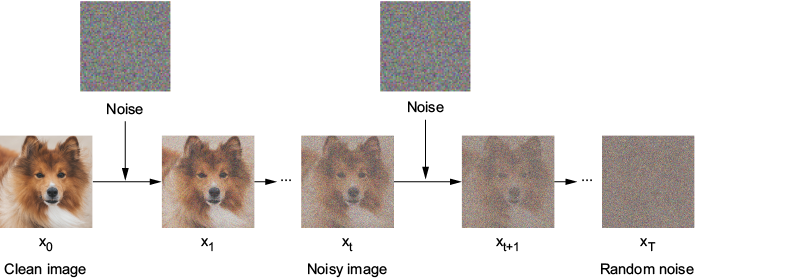
Trace the forward process from a clean dog image x₀ through successive noisy images to random noise at time step 1,000. section 1.3.1
