The noisy intermediate-scale quantum era (NISQ) describes quantum devices large enough to evade classical simulation but too small and noisy for practical, broadly useful computation. Their limitations make hardware development, software, and algorithm design inseparable. section 1.10 section 1.3.2
NISQ systems are characterized by:
- Imperfect qubits and insufficient fault tolerance for long computations. section 1.3.2
- A gap between experimental computational scale and useful problem-solving capability. section 1.10
- A software stack that executes algorithms on hardware, exposes quantum systems through the cloud, and informs hardware requirements. section 1.10
- Active hardware approaches including superconducting circuits, trapped ions, neutral atoms, and photons. section 1.3.2
From demonstrations to fault tolerance
Early nuclear magnetic resonance devices demonstrated small algorithms such as Deutsch, Deutsch–Jozsa, and Grover’s search. The next major target is a fault-tolerant machine capable of long computations, followed by practical problems beyond classical reach. section 1.3.2 section 1.8
Figure 1.2 The major milestones of quantum hardware development. The first two, showing the use of quantum mechanics to perform a computation and having a quantum computer solve an artificial problem that a classical computer cannot, have already been achieved. The next milestone, building a fault-tolerant quantum computer that can run long computations, is the current focus. The final goal is to build a quantum computer that can solve practical problems that a classical computer cannot.
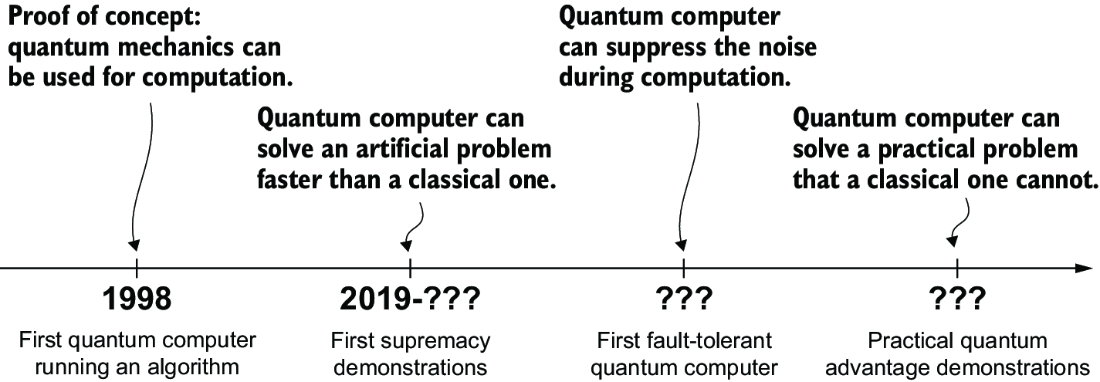
Use the hardware-milestones figure to distinguish achieved demonstrations from the current fault-tolerance goal and the eventual practical-advantage goal. section 1.3.2
