Nominal data is qualitative, nonnumerical data whose labels have no inherent order. City names and gender identity labels are nominal; unlike ordinal values, they cannot be ranked by magnitude. section 3.1.2
Use the data type to guide visualization decisions:
- Represent nominal categories with categorical colors rather than sequential or diverging palettes, which suit ordered values. section 3.1.2
- Classify attributes before choosing visual channels; qualitative data can also use patterns, symbols, connections, or enclosure. section 14.2
- Select D3 scales appropriate for qualitative data instead of treating nominal categories like quantitative values on a linear scale. section 3.1.2
A visualization planning exercise
List every dataset attribute, mark each as quantitative or qualitative, and brainstorm an encoding for the main attributes. A city-name field can become categorical color or another qualitative channel, while numerical fields may use position, length, area, or angle. section 14.2
Figure 3.4 A classification of data types
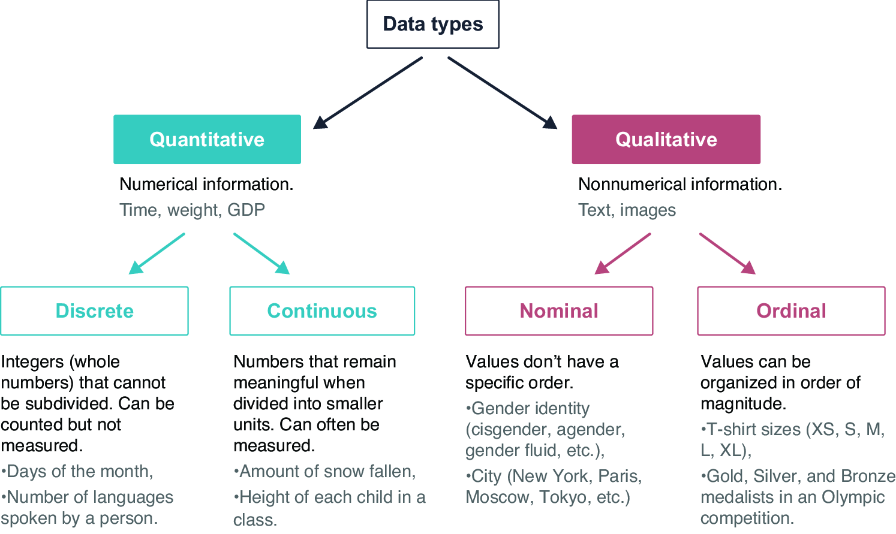
Use the data-type classification to distinguish nominal and ordinal qualitative values from discrete and continuous quantitative values. section 3.1.2



