A non-fungible token (NFT) is a unique blockchain-based token used to represent ownership of, or provenance for, a specific digital asset. Unlike an ordinary database record, each token identifies a particular digital item. section 8.1
A practical shop scenario makes the idea concrete: when Alpaca-Ma-Bags creates an NFT, it stores both a reference to the token and its image alongside the customer’s order data. Partners can then access those images through a public-facing API. section 8.1
The surrounding design highlights three useful boundaries:
- Treats the NFT as a unique digital asset, not as advice about trading, valuation, acquisition, or investment. section 8.1
- Stores application-facing metadata and images while leaving blockchain mechanics outside the implementation discussion. section 8.1
- Uses a serverless API to make NFT-related images accessible to partners with scalable, low-cost delivery. section 8.1
Figure 8.2 An API has endpoints, which are often HTTP URLs that can be accessed over the Internet.
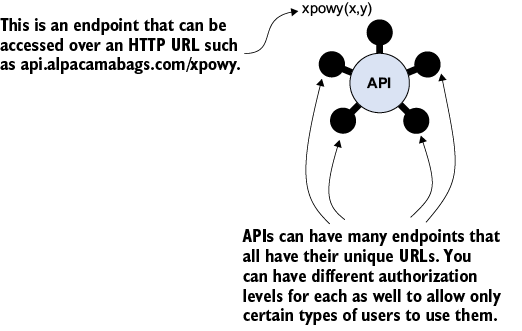
Use the endpoint diagram to follow how partner applications reach NFT-related data through HTTP URLs. section 8.1
