Non-maximum suppression (NMS) de-duplicates object detections. Region proposal networks produce many boxes for the same object because nearby anchors independently predict it. Keeping every overlapping proposal would create a redundant set of regions of interest (RoIs), so NMS retains strong candidates and suppresses highly overlapping alternatives. section 11.4.2
Given bounding boxes, confidence scores, and an overlap threshold, NMS repeatedly selects the highest-scoring remaining box, adds it to the output, and compares it with the boxes left. Any remaining box whose intersection over union (IoU) with the selected box exceeds the threshold is removed. The result is a filtered set of boxes rather than many near-duplicates. section 11.4.2
A typical region-proposal pipeline applies NMS after earlier filtering steps:
- Convert predicted offsets into bounding-box coordinates, then clip boxes to image boundaries. section 11.4.2
- Discard boxes smaller than a minimum height or width, score the survivors by objectness, and sort them. section 11.4.2
- Keep a pre-NMS candidate set, run NMS with a 0.7 threshold, then retain the top post-NMS RoIs. section 11.4.2
From overlapping anchors to a compact RoI set
In an RPN, anchors are sampled at a stride of 16 pixels, so one reasonably sized object may be predicted by multiple anchors. NMS at a 0.7 threshold suppresses highly overlapping proposals. The illustrated result reduces 24 bounding boxes before NMS to 4 afterward, leaving a more useful RoI set for the R-CNN. section 11.4.2
NMS is also used after Fast R-CNN produces class scores and class-specific box offsets. At this stage it runs separately within each class: overlapping boxes for the same class compete, while overlapping boxes assigned to different classes are not suppressed merely for overlapping. section 11.4.3
In PyTorch, `torchvision.ops.nms(rois, objectness_scores, nms_threshold)` returns indices of retained RoIs. Those indices can then select the post-NMS boxes, with separate limits for training and testing. section 11.4.2
Figure 11.17 The left column shows the bounding boxes (24) before NMS. The right column shows the bounding boxes (4) that remain after NMS.
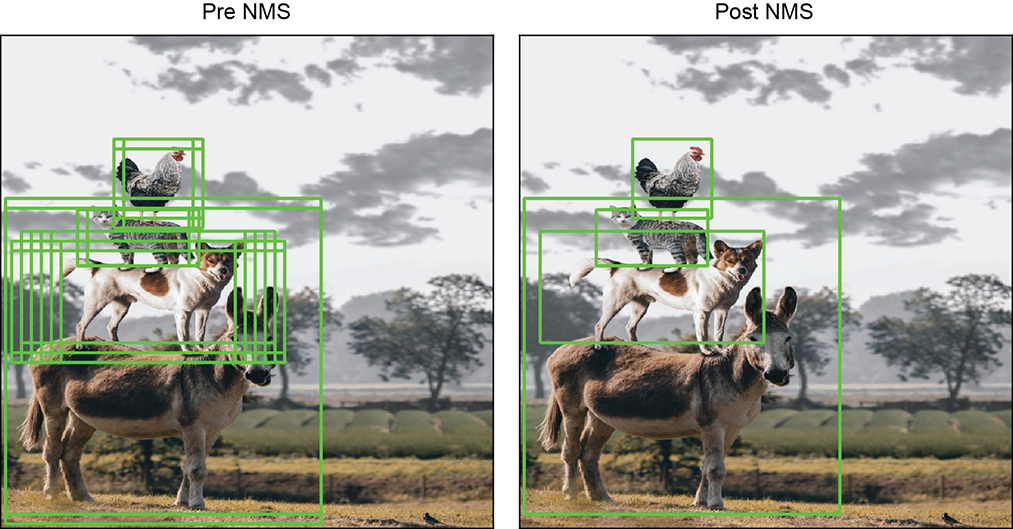
Compare the dense pre-NMS proposals with the four boxes retained after suppression to see how overlap-based de-duplication compresses detections. section 11.4.2
