A non-reasoning model produces output in a single forward pass without an explicit deliberation phase. It can attempt many tasks, but multistep problems may receive plausible-sounding, shallow answers. section 5.1
Use this contrast to choose an appropriate reasoning strategy:
- Non-reasoning models keep deliberation implicit and bounded by one pass. section 5.1
- Reasoning models add an explicit thinking phase, spending more tokens and latency on harder problems. section 5.1
- Chain-of-thought prompting can elicit intermediate steps, improving multistep performance without adding a new underlying capability. section 5.1
Routine planning
A simple “leaving home” plan—get dressed, check the toaster, grab keys, and leave—illustrates why explicit decomposition helps when a model cannot rely on learned routines or a rich world model. section 5.1
Figure 5.1 Different prompting strategies for reasoning and non-reasoning models
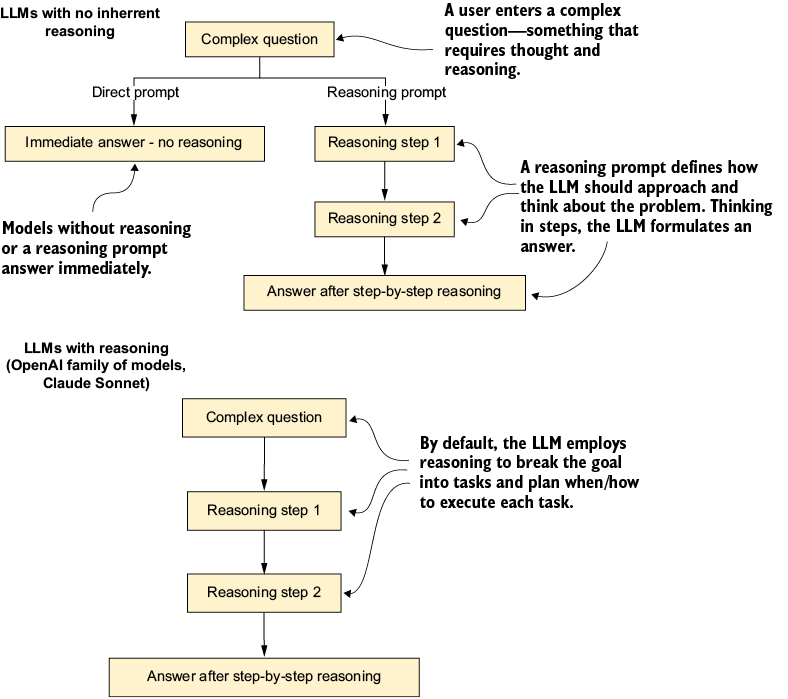
Compare prompting strategies for reasoning and non-reasoning models. section 5.1
