liveBook · Manning

Nondominated solution

As explained in Optimization Algorithms: AI techniques for design, planning, and control problems

A feasible multi-objective solution for which no other feasible solution is at least as good in every objective and strictly better in one.

A nondominated solution is a feasible alternative that cannot be improved in one objective without worsening another. Together, such trade-off-optimal alternatives form a Pareto frontier. section 1.3.2 section 8.9

Electric-vehicle design

Suppose designs seek both greater EPA range and faster acceleration. A design on the Pareto frontier remains attractive because improving one measure would require sacrificing the other; a higher-level decision then selects among the alternatives. section 1.3.2

Distinguish nondominated solutions from single-score optimization:

  • Weighted optimization combines objectives into one score, but choosing the preference vector or weights can be subjective. section 1.3.2
  • Pareto optimization preserves multiple trade-off choices, which can later be refined through higher-level information or decision-making. section 8.9
  • Constraint-satisfaction problems instead seek feasible solutions without defining an explicit objective function; the 4 × 4 n-queen problem has two equally acceptable solutions. section 1.3.2
Figure 1.6 Electric vehicle design problem for maximizing EPA range and minimizing acceleration time
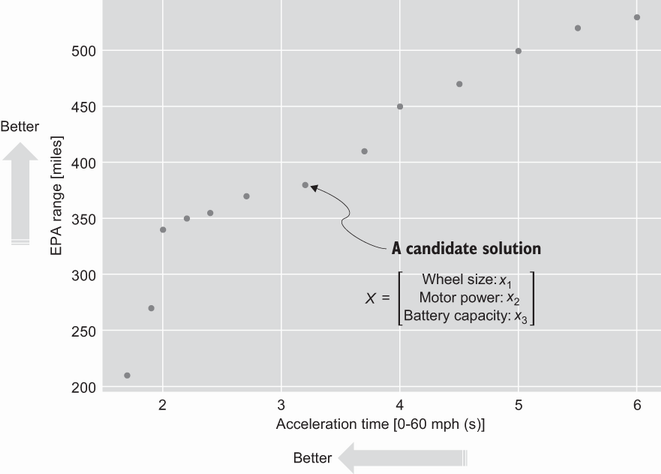
Use the electric-vehicle design figure to visualize competing objectives and the alternatives that motivate a Pareto frontier. section 1.3.2


How Optimization Algorithms: AI techniques for design, planning, and control problems covers it

How deep it goes
Defines Pareto optimization and contrasts it with weighting, but leaves detailed multi-objective algorithms for later treatment.
Examples
Uses electric-vehicle range and acceleration, plus the 4 × 4 n-queen constraint-satisfaction problem.
What it assumes
Assumes familiarity with objective functions, maximization, minimization, and feasible solutions.
What you can do after
Evaluate trade-off alternatives and defer final selection to higher-level preferences or decision-making.
How it connects
Connects multi-objective optimization with objective functions, scalarization, Pareto frontiers, and preference-based decision-making.

Also explained in

Compare how 2 books explain nondominated solution →

Related concepts

This explainer was generated by Manning's knowledge graph from the text of Optimization Algorithms: AI techniques for design, planning, and control problems. The section links point to the parts of the book it draws on.