liveBook · Manning

Nonfunctional requirement

As explained in Microservices Patterns, Second Edition

A non-functional requirement specifies how well an application performs its functions or how easily it can be developed and maintained.

A non-functional requirement specifies how well an application performs its functions and how easily it can be developed and maintained. These requirements are closely tied to architecture. section 3.1.3

They describe two aspects of an application:

  • Runtime behavior, such as scalability and performance. section 3.1.3
  • Development-time characteristics, such as how easily the application can be changed and deployed. section 3.1.3

FTGO performance target

One example is handling 233 create-order requests per second with an average response time of 356 milliseconds. section 3.1.3

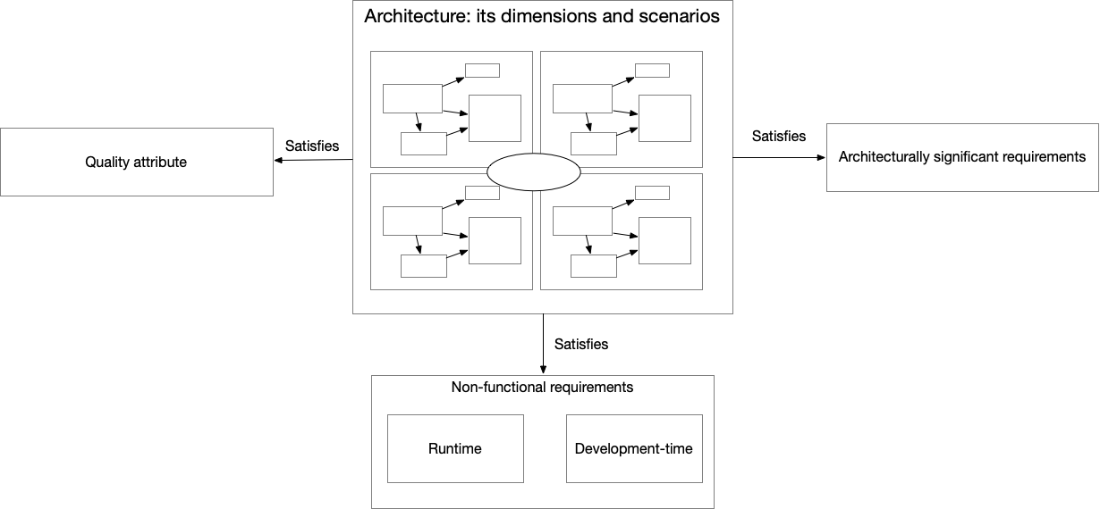
Figure 3.2 Three different perspectives on the purpose of an architecture’s architecture, which is multidimensional: traditional non-functional requirements, modern architecturally significant requirements, and quality attributes
purpose of architecture

Compare the traditional non-functional-requirements perspective with architecturally significant requirements and quality attributes. section 3.1.3


How Microservices Patterns, Second Edition covers it

How deep it goes
Distinguishes runtime behavior from development-time concerns and gives brief examples.
Examples
Uses an FTGO throughput and response-time target, plus availability and modifiability scenarios.
What you can do after
Understand how runtime and development-time requirements constrain architectural choices.
How it connects
Connects non-functional requirements with functional requirements, software architecture, architecturally significant requirements, and quality attributes.

Also explained in

Compare how 9 books explain nonfunctional requirement →

Related concepts

This explainer was generated by Manning's knowledge graph from the text of Microservices Patterns, Second Edition. The section links point to the parts of the book it draws on.