Nonlinear programming (NLP) describes an optimization problem whose objective function or at least one constraint is nonlinear. Such problems are harder to solve than linear problems. Quadratic programming is a special case in which the objective function is quadratic. section 2.1.4
The distinction matters because the objective and constraints determine the problem’s mathematical structure, while the number and type of decision variables, objectives, and constraints determine its broader classification. section 2.1.4 section 2.5
Classify a nonlinear optimization problem along several dimensions:
- Use univariate or multivariate to describe the number of decision variables. section 2.5
- Use continuous, discrete, or mixed-integer to describe decision-variable types. section 2.5
- Use mono-objective, multi-objective, or constraint-satisfaction to describe the optimization goal. section 2.5
- Use unimodal, multimodal, or deceptive to describe the objective-function landscape, and constrained or unconstrained to describe restrictions. section 2.5
Plant layout as quadratic assignment
A plant layout problem assigns facilities to locations while minimizing total material-handling cost. Pairwise cost is modeled as flow multiplied by distance, and the assignment formulation minimizes trace(WXDXᵀ), where W is the flow matrix, D the distance matrix, and X the assignment vector. section 2.1.4
Figure 2.9 Plant layout problem—what is the optimal location for each department that minimizes the overall material handling costs?
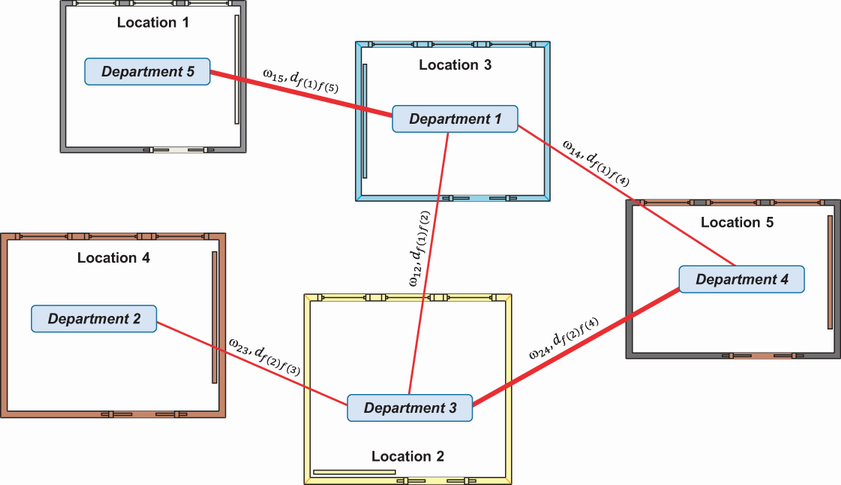
Use the plant-layout figure to inspect the facility-location decision that the quadratic assignment formulation represents. section 2.1.4
